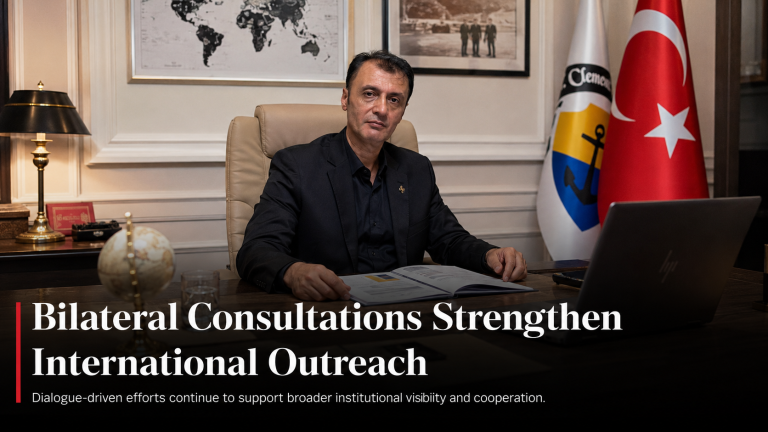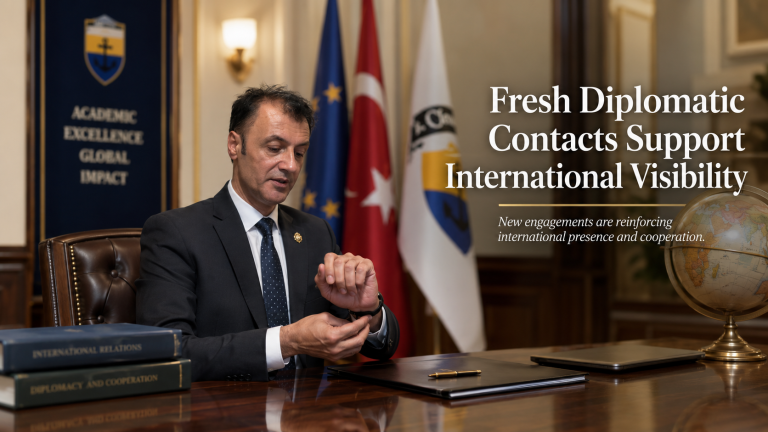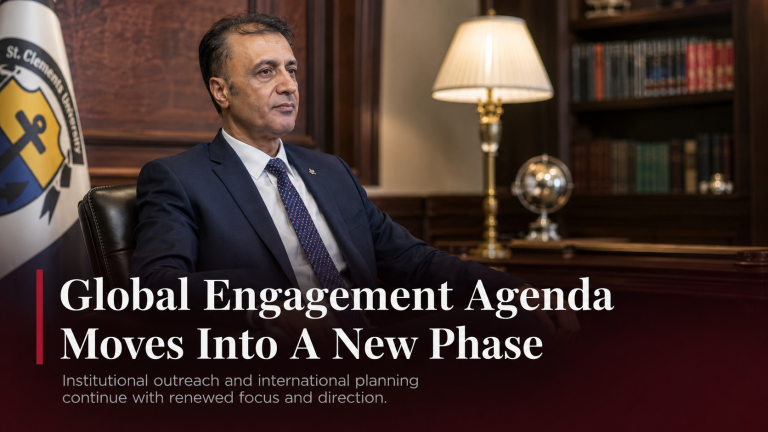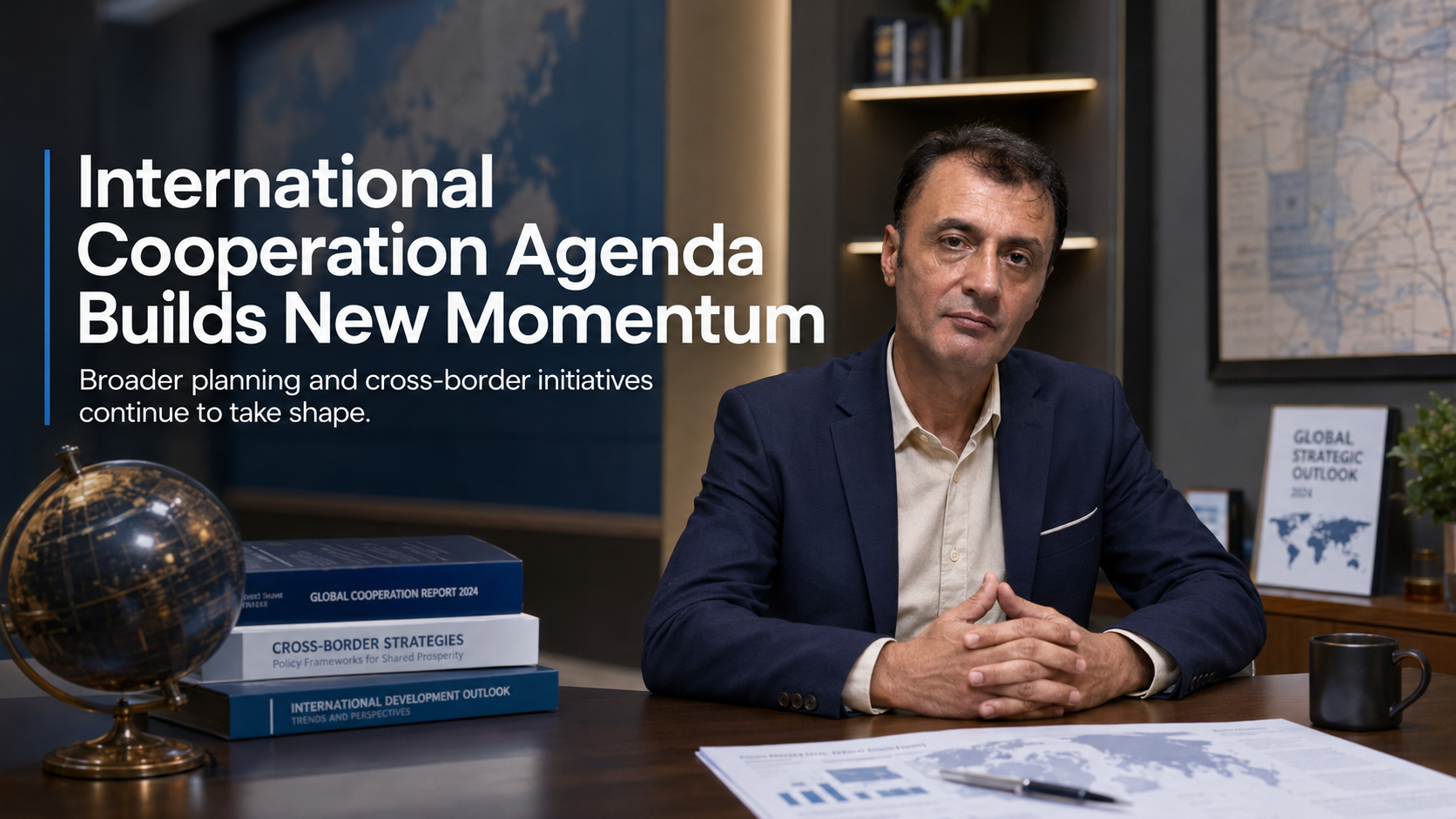
New engagements are reinforcing international presence and cooperation as sustained dialogue, institutional diplomacy and strategic outreach create broader opportunities for cross-border partnership development.
Fresh diplomatic and institutional contacts are supporting a new period of international visibility as dialogue-driven outreach develops across academic, cultural, professional and strategic networks.
Under the direction of Prof. Dr. Bilal Semih Bozdemir, the evolving engagement agenda places increased emphasis on creating credible communication channels with institutions, international representatives, universities, professional organisations and globally oriented public bodies.
The initiative does not treat international visibility as an objective that can be achieved through publicity alone. Instead, visibility is approached as the result of sustained communication, institutional credibility and practical cooperation.
A new contact becomes meaningful when it leads to a better understanding of shared priorities. An introductory meeting becomes valuable when responsibilities and possible next steps are identified. International visibility becomes durable when it is supported by documented relationships and activities capable of producing academic, cultural or professional value.
The latest phase therefore brings together diplomatic communication, academic outreach, public engagement and institutional follow-through within a more coordinated framework.
International presence built through credible dialogue
International visibility is sometimes associated primarily with media exposure, ceremonial appearances or participation in global events.
These elements can contribute to public awareness, but they do not independently create a reliable international presence.
Institutions gain long-term recognition when other organisations understand their mission, experience their professionalism and identify credible reasons to remain in contact.
Dialogue is therefore central to the developing outreach model.
An introductory communication should not simply announce the existence of an institution or representative. It should explain the purpose of the approach, identify potential common interests and propose a realistic form of engagement.
The initial objective may be modest.
It might involve an exchange of institutional information, an online consultation, an invitation to an academic event or a discussion concerning future cooperation.
What matters is whether the communication establishes a reliable foundation for further work.
Understanding the meaning of diplomatic contact
Diplomatic contact can occur through several channels.
Some relationships involve official diplomatic missions or public authorities. Others develop through universities, international organisations, cultural institutions, professional networks and civil-society structures.
Academic diplomacy, cultural diplomacy and public diplomacy all contribute to international engagement without replacing formal state diplomacy.
Universities create relationships through research, education and student mobility. Museums and cultural institutions connect societies through heritage and public education. Professional organisations exchange expertise, while media platforms introduce international initiatives to wider audiences.
These forms of contact can reinforce one another.
An academic meeting may lead to a research partnership. A research project may support an international conference. A cultural institution may host a public event connected to the project. Media coverage may extend its reach.
The developing agenda recognises this wider diplomatic ecosystem and seeks to connect its different elements through responsible institutional coordination.
Fresh contacts require careful assessment
A new international contact should be welcomed as an opportunity, but not automatically treated as a completed partnership.
The identity, authority and institutional relevance of the participants must be understood.
An individual may hold an impressive title yet lack the authority to make commitments on behalf of the organisation concerned. A department may be able to participate in an academic activity without possessing institution-wide decision-making powers.
Responsible engagement therefore begins with verification.
Official institutional websites, government registers, recognised directories, accreditation records and direct confirmation from authorised offices may all contribute to the assessment process.
The appropriate level of verification depends on the nature of the proposed activity.
A public webinar may require relatively straightforward confirmation. A cooperation framework involving funding, student participation, institutional representation or long-term contractual obligations requires more extensive due diligence.
Verification protects all participants and allows legitimate opportunities to proceed with greater confidence.
From introductory meetings to working relationships
The first meeting between institutions is usually exploratory.
Participants introduce their responsibilities, describe their priorities and consider whether areas of compatibility exist.
A productive initial meeting should create clarity rather than premature commitments.
The discussion may examine:
- the institutional role of each participant;
- shared academic, cultural or professional interests;
- possible forms of cooperation;
- necessary authorisations;
- documentation requirements;
- operational and financial limitations;
- the most suitable next step;
- the officials responsible for follow-up.
The meeting should be followed by a written record.
This may take the form of a short summary, minutes or an exchange of emails confirming the matters discussed.
Written follow-through helps ensure that each side has the same understanding of the conversation. It also allows additional institutional representatives to become involved without losing the history of the relationship.
Academic diplomacy as a lasting bridge
Academic diplomacy is among the most durable forms of international engagement.
Universities and research institutions create relationships based on knowledge, teaching and scholarly exchange. These relationships can continue despite political changes and provide long-term connections among students, researchers and academic leaders.
Fresh contacts may create opportunities for:
- international guest lectures;
- collaborative research;
- student and faculty engagement;
- academic conferences;
- joint publications;
- advisory boards;
- professional development;
- digital education;
- progression and articulation discussions;
- credit-transfer evaluation.
The first stage should normally focus on compatibility.
Institutions need to understand one another’s academic authority, programme structure, quality-assurance procedures and international priorities before proposing complex arrangements.
A general academic consultation can develop gradually.
A guest lecture may lead to a joint seminar. A seminar may produce a research working group. Successful research cooperation may later support a more formal institutional framework.
This gradual development creates evidence of trust and operational capacity.
Diplomatic visibility through education
Education has a distinctive role in international relations because it creates relationships extending across generations.
A student participating in an international programme gains more than academic knowledge. The student encounters another institutional culture, forms professional relationships and develops a broader understanding of the world.
Faculty members involved in international teaching or research also create lasting networks.
These relationships can strengthen institutional reputation in ways that conventional promotion cannot easily reproduce.
However, international education must remain transparent.
Students should know which institution provides the teaching, which organisation maintains their records and which authority issues any resulting certificate or qualification.
Recognition and professional licensing should be described accurately.
The right of an institution to offer a programme in one jurisdiction does not automatically guarantee the acceptance of its qualification in every other country.
Responsible academic diplomacy therefore combines opportunity with clear disclosure.
Cultural diplomacy and public understanding
Cultural dialogue can support international visibility by making institutional cooperation accessible to the public.
Museums, archives, libraries, historical organisations and cultural media platforms can introduce international audiences to shared heritage and different national perspectives.
Potential activities include exhibitions, public lectures, digital archives, cultural publications, museum education and documentary projects.
These initiatives can create relationships even where formal political engagement is limited.
Cultural diplomacy is particularly effective when it is based on scholarship and respectful interpretation rather than superficial symbolism.
International cultural projects should therefore address questions concerning provenance, intellectual property, translation, ownership, transportation and public presentation.
Visibility becomes more valuable when it is connected to credible content and institutional responsibility.
Public diplomacy in a digital environment
Digital media has transformed public diplomacy.
Institutions can now communicate with international audiences directly through websites, social platforms, online conferences, academic publications and multilingual news services.
This creates considerable opportunities.
A small or specialised institution can reach audiences far beyond its physical location. Academic work can be presented internationally. Events can include participants from several continents without requiring extensive travel.
The same environment also creates risks.
Information can be distributed rapidly before it has been properly verified. Exploratory discussions may be presented as completed agreements. Images and institutional symbols may be used in ways that imply endorsement without formal authorisation.
The new outreach phase therefore requires a disciplined digital communication policy.
Every public statement should reflect the actual status of the relationship.
A first contact is not a partnership. A meeting is not necessarily an agreement. A non-binding memorandum is not an operational programme.
Explaining these distinctions does not weaken international visibility. It protects its credibility.
Strategic communication and institutional reputation
International reputation is built cumulatively.
Each email, meeting, document and public announcement contributes to how an institution is perceived.
Clear communication demonstrates professionalism. Accurate claims establish trust. Timely responses show reliability. Respect for institutional procedures reduces friction.
Conversely, exaggerated announcements or inconsistent information can damage relationships quickly.
Strategic communication should therefore serve several purposes:
- present the institution accurately;
- explain the objective of the outreach;
- identify relevant areas of expertise;
- demonstrate respect for the recipient;
- communicate the actual status of discussions;
- provide evidence for important claims;
- maintain consistent terminology.
The tone should remain professional without becoming impersonal.
International engagement is ultimately conducted between people, even when they represent complex institutions.
Warmth and respect can support trust, but they must be accompanied by precision.
Bilateral engagement as the first practical level
Many international relationships begin bilaterally because cooperation between two institutions is easier to manage during the early stages.
A bilateral consultation allows both sides to understand expectations, test communication and identify a suitable pilot activity.
The parties may begin with a limited programme such as an online seminar, research meeting, professional workshop or cultural presentation.
If the project is successful, the relationship can expand.
Additional departments or organisations may become involved. A bilateral project may develop into a multilateral network connecting universities, professional bodies, cultural institutions and publishing platforms.
This progression should remain gradual.
Bringing too many participants into an untested relationship can create uncertainty concerning leadership, communication and responsibility.
A functioning bilateral foundation provides greater stability for later expansion.
Multilateral networks and wider international reach
Multilateral cooperation can significantly strengthen international visibility.
A network involving organisations from several countries can reach larger audiences, combine specialist resources and introduce a project to multiple institutional environments.
However, multilateral activity requires strong governance.
Participants should understand:
- the shared objective;
- their respective responsibilities;
- decision-making procedures;
- funding arrangements;
- ownership of project materials;
- communication protocols;
- standards for public announcements;
- mechanisms for resolving disagreement.
Without these elements, a broad network may become difficult to manage.
The developing agenda therefore treats network expansion as an institutional process rather than a numerical objective.
The value of a network lies in the quality of interaction among its participants, not merely in the number of logos displayed.
Professional networks as diplomatic assets
Professional organisations can contribute substantially to international relations.
Engineers, psychologists, medical specialists, lawyers, educators, researchers, journalists and cultural professionals all belong to networks that cross national boundaries.
These communities share technical terminology, professional standards and practical challenges.
Diplomatic outreach connected to professional expertise can therefore produce immediate areas of cooperation.
A mining-related network may examine environmental responsibility, occupational safety and workforce development. A psychological initiative may focus on ethical practice, research and professional education. A media partnership may support multilingual publishing and international public communication.
Professional credibility strengthens diplomatic engagement because it provides a substantive reason for institutions to remain connected.
Research partnerships and shared global challenges
Fresh contacts can also create new research opportunities.
Many global problems require comparative evidence from different countries.
Public health, climate change, migration, digital transformation, cultural preservation and economic development cannot be studied adequately from one national perspective alone.
International research makes it possible to compare policies, populations and institutional responses.
Different partners may contribute data, methodology, technical infrastructure or publication capacity.
Before research begins, the parties should clarify ethical approval, data protection, authorship, intellectual property and funding.
These matters are not secondary administrative details. They are essential to the legitimacy of the research.
A properly governed research project can become one of the strongest forms of international visibility because it produces knowledge that is useful beyond the participating institutions.
Pilot initiatives create evidence
Fresh international contacts should often be tested through limited pilot initiatives.
A pilot gives participants an opportunity to assess communication and institutional reliability before entering a larger commitment.
Possible pilot activities include:
- an international webinar;
- a diplomatic or academic roundtable;
- a guest lecture;
- a comparative research discussion;
- a short professional training session;
- a cultural presentation;
- a joint article or policy paper;
- a digital public-awareness project.
The pilot should have a clear objective and identifiable output.
After completion, the parties should review what worked and what needs improvement.
A successful pilot may support a more ambitious relationship. A difficult pilot may reveal problems that can still be corrected. It may also demonstrate that the proposed partnership is not currently suitable.
Both success and difficulty provide useful evidence.
Documentation supports continuity
International visibility becomes more durable when communication is preserved within an institutional system.
Contact details, meeting notes, proposals, replies and agreed actions should be recorded.
This allows the relationship to continue when individual representatives change roles or become unavailable.
Documentation should include the source of contact information and the authority of the person involved.
It should also distinguish public information from confidential material.
A mature system may classify each relationship according to its current status:
- Contact identified
- Preliminary verification completed
- Introductory communication sent
- Reply received
- Consultation arranged
- Documents exchanged
- Institutional evaluation continuing
- Pilot initiative proposed
- Formal framework under review
- Active cooperation
- Temporarily paused
- Closed
Such classification helps prevent early dialogue from being represented as a completed partnership.
Digital tools and responsible outreach
Digital systems can support a broad international contact programme.
They may help identify relevant institutional offices, organise correspondence, schedule reminders and prevent duplicate communication.
These tools are particularly useful when multiple countries and sectors are involved.
Yet automated outreach must remain targeted.
Mass communication that ignores the recipient’s institutional role may reduce response quality and damage reputation.
Contact information should be collected from lawful, public and verifiable sources. Messages should provide a clear institutional identity and legitimate reason for contact.
Human review remains essential.
Technology can locate an international office, but it cannot independently determine whether a proposed relationship is strategically appropriate or legally possible.
The strongest model combines digital efficiency with institutional judgement.
Multilingual diplomacy
Language plays an important role in building international trust.
English is widely used in academic and diplomatic communication, but providing selected materials in the recipient’s language can improve understanding and demonstrate respect.
Translations must remain accurate.
Terms such as accreditation, recognition, representation, cooperation and partnership may have different legal implications across jurisdictions.
Formal documents should identify which language version is authoritative.
Communication should also reflect cultural differences in hierarchy and decision-making.
Some institutions prefer direct correspondence. Others require formal letters and several stages of internal referral.
These differences should be respected without compromising essential standards of clarity and verification.
Due diligence protects international reputation
Fresh contacts can create opportunity, but they can also introduce risk.
International relationships may involve academic, legal, financial, reputational or political considerations.
Warning signs can include unclear institutional status, inconsistent titles, refusal to provide documentation, pressure for rapid payment and unsupported claims concerning recognition or official authority.
Such concerns should be examined carefully.
Due diligence does not require treating every new contact with suspicion. It requires distinguishing enthusiasm from evidence.
Where necessary, the relationship may remain exploratory until relevant information is confirmed.
A credible institution should understand and respect reasonable verification procedures.
Financial transparency in emerging cooperation
Even preliminary international activity can involve costs.
Translation, technology, travel, events, staff time, legal consultation and communication all require resources.
Pilot projects should therefore include basic financial planning.
The parties need to understand which organisation is responsible for each cost and whether external funding is required.
More complex projects should address payment schedules, banking arrangements, revenue sharing, cancellation procedures and reporting.
Where students or public participants pay fees, the level of transparency must be especially high.
International visibility should never be pursued through unclear financial commitments.
Sustainable cooperation depends on realistic budgeting.
Measuring international visibility responsibly
Visibility should be evaluated through more than media impressions or publication numbers.
Meaningful indicators may include:
- verified institutions entering dialogue;
- international meetings producing defined actions;
- pilot projects implemented;
- research outputs completed;
- students or professionals receiving identifiable benefit;
- continued relationships after the first year;
- increased participation in international networks;
- accurate and responsible public communication.
A smaller number of credible contacts may produce greater long-term visibility than a large volume of superficial outreach.
The objective is recognition based on substance.
Leadership and long-term institutional capacity
Personal leadership frequently initiates international contact.
A committed representative identifies potential partners, opens communication and maintains momentum through administrative delays.
For the agenda to become sustainable, personal engagement must be converted into institutional capacity.
Correspondence should be archived. Responsibilities should be shared. Official channels should support major decisions. More than one authorised person should understand the status of important relationships.
Prof. Dr. Bilal Semih Bozdemir’s role within the developing outreach framework reflects this need to connect leadership with continuity.
The wider ambition is to create a network capable of expanding across academic, cultural, professional and public-diplomacy fields without becoming dependent on isolated conversations.
A renewed international presence
The appearance of fresh contacts represents a positive development, but the real significance lies in what those contacts can produce.
A new introduction may open a door. Sustained dialogue determines whether the door leads to meaningful cooperation.
The developing agenda is therefore moving carefully from visibility toward substance.
Potential partners are being evaluated. Communication is being organised. Pilot projects are being considered. Public statements are being aligned with documented progress.
This process may take time, but it offers stronger institutional foundations.
Looking ahead
The next phase is expected to involve further consultations with credible and responsive institutions.
Priority may be given to relationships offering a realistic basis for academic projects, cultural engagement, professional exchange or public diplomacy.
Some contacts may develop quickly, while others require extended internal review.
New opportunities will continue to be explored, but visibility alone will not determine priority.
The central questions will remain practical: Is the institution legitimate? Is the contact authorised? Is the proposed cooperation feasible? Can it create mutual and lasting value?
Visibility founded on meaningful engagement
Fresh diplomatic and institutional contacts can significantly strengthen international presence when they are managed responsibly.
They introduce institutions to new networks, support dialogue across cultures and create pathways for academic, professional and public cooperation.
Their long-term value depends on trust, accuracy and continuity.
Under the developing engagement agenda led by Prof. Dr. Bilal Semih Bozdemir, international visibility is being approached as the outcome of sustained institutional work rather than a temporary communications objective.
The central principle is clear: international presence grows most effectively when new contacts are verified, dialogue is maintained and visibility is supported by cooperation capable of producing genuine value.
Related coverage