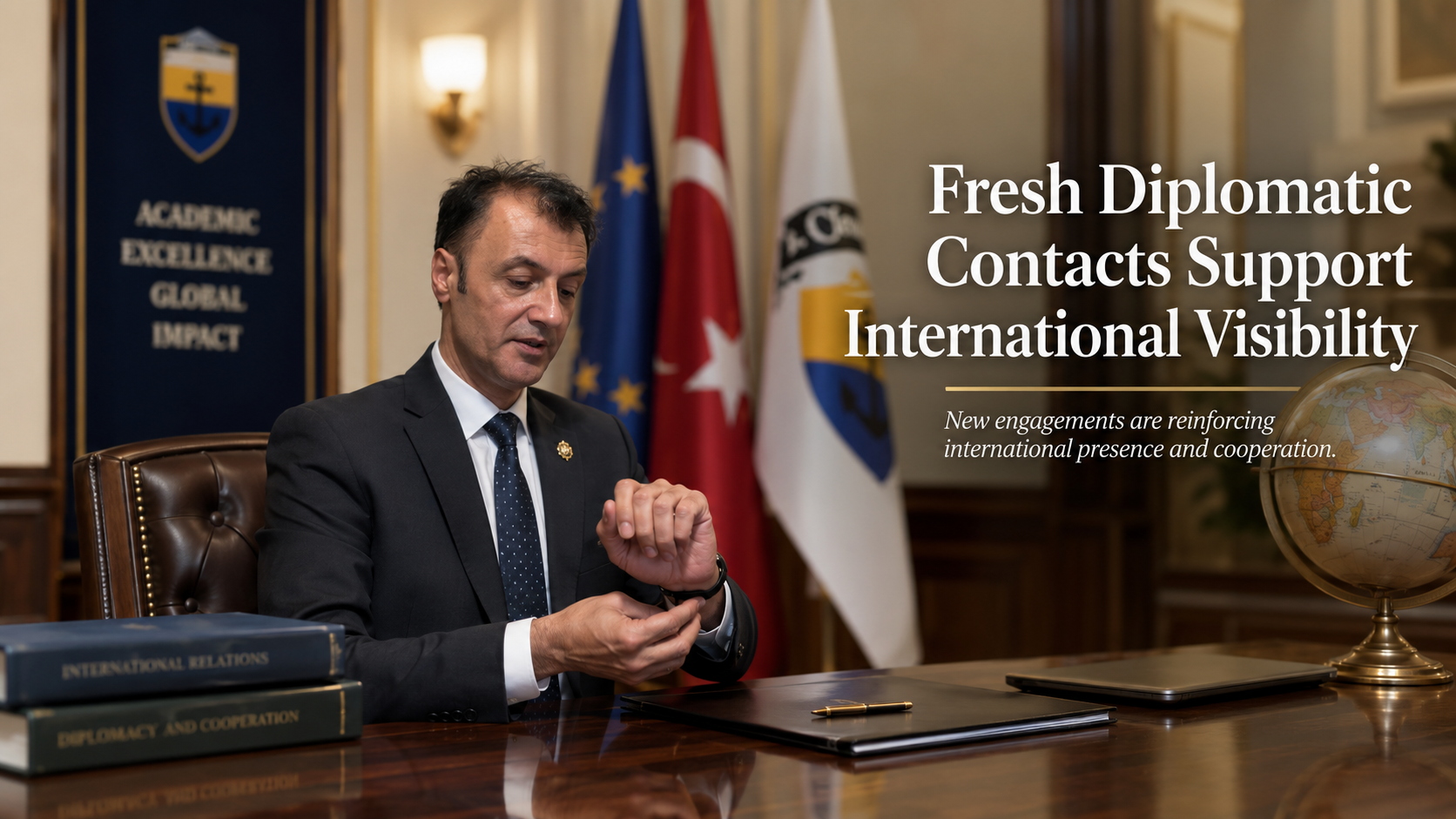
International visibility grows through sustained communication, multilingual publishing and coordinated outreach as academic, professional and institutional networks connect with increasingly diverse audiences.
Global networking efforts are reaching wider audiences as sustained international communication, digital publishing and structured institutional outreach create new connections across countries, professional sectors and academic communities.
Under the strategic direction of Prof. Dr. Bilal Semih Bozdemir, the developing engagement framework brings together international relations, academic diplomacy, professional networking, media communication, cultural dialogue and digital audience development.
The latest phase reflects an understanding that international visibility cannot be created through isolated announcements or occasional contact. A durable global presence requires regular communication, relevant content, credible institutional relationships and the technical capacity to reach audiences through multiple languages and platforms.
The objective is therefore broader than attracting attention.
The developing strategy seeks to connect institutions and individuals around identifiable areas of shared interest, including education, scientific research, professional development, cultural heritage, international cooperation and public communication.
Global networking becomes meaningful when communication produces relationships, relationships create opportunities and those opportunities lead to measurable academic, professional or social value.
From international contact to connected communities
Traditional international outreach often focused on one-to-one institutional correspondence.
A university contacted another university. A professional organisation approached a potential partner. A representative attended a meeting and exchanged information with a limited number of participants.
These methods remain important, but digital communication has greatly expanded the potential scale of engagement.
A single publication can now reach academics, students, professionals, policymakers and members of the public in several countries. An online meeting can connect participants from different continents. A multilingual website can introduce an initiative to audiences that would otherwise remain outside its immediate network.
This wider reach changes the nature of international networking.
Communication is no longer limited to a small circle of authorised officials. It can create broader communities of interest around particular projects, institutions and subject areas.
However, wider reach also creates additional responsibilities.
Messages must remain accurate. Institutional authority must be represented correctly. Audiences need to understand whether a project is exploratory, under development or fully operational.
The ability to reach thousands of people does not reduce the need for precision. It increases it.
Networking built on sustained communication
A global network does not emerge from a single message.
It develops through repeated and purposeful communication.
Institutions need time to understand one another. Professional contacts must observe whether information is reliable and whether agreed actions are completed. Audiences also require consistent content before they begin to recognise an initiative as a credible international presence.
Sustained communication may include:
- institutional news reports;
- academic articles;
- professional commentary;
- project updates;
- international interviews;
- conference announcements;
- research summaries;
- cultural features;
- newsletters;
- direct partnership correspondence;
- online meetings and public events.
Each channel serves a different purpose.
Direct correspondence supports institutional decision-making. Public news creates visibility. Academic articles establish intellectual credibility. Social and digital media help distribute information to wider audiences.
A coordinated networking strategy connects these channels rather than treating them as separate activities.
A research project may generate a scholarly article. The article can be summarised for a general audience. The findings may then be discussed in an online seminar and shared with relevant professional organisations.
The result is not simply more content. It is a connected communication process through which one initiative can reach several distinct audiences.
International visibility as an institutional outcome
Visibility is often discussed as though it were principally a marketing objective.
In a credible global network, visibility should be understood as an institutional outcome.
An organisation becomes internationally visible when other institutions recognise its work, engage with its representatives and identify a reason to maintain communication.
Media exposure may support that process, but attention without institutional substance is unlikely to produce durable relationships.
The developing networking framework therefore connects public visibility with practical activity.
A report about an international meeting should explain its purpose and status. A publication concerning a prospective partnership should avoid suggesting that negotiations are complete when they remain exploratory.
A feature concerning academic cooperation should distinguish between a general memorandum and an approved programme.
This accuracy protects institutional reputation.
It also allows audiences to follow the progression of an initiative from initial contact through consultation, project design and implementation.
Visibility grounded in documented progress creates greater confidence than visibility based on exaggerated claims.
Digital platforms as gateways to international audiences
Digital platforms have become essential gateways for global networking.
Institutional websites, online newspapers, academic journals, professional directories, research platforms and social networks each reach different segments of the international audience.
A central website can provide official information and preserve a permanent record of activities. A news platform can report developments in an accessible format. An academic journal can present detailed scholarly work. Professional platforms can connect projects with practitioners and sectoral organisations.
The effective use of these channels requires planning.
The same content should not simply be copied without adaptation across every platform. A long academic article may need a concise summary for professional networking. A formal institutional announcement may require a more explanatory version for the general public.
Each item should preserve the essential facts while responding to the expectations of the audience receiving it.
Digital publishing should also maintain consistency in names, titles, programme descriptions and institutional status.
Inconsistent information creates confusion and can weaken credibility across the entire network.
Multilingual publishing and international access
Language remains one of the most significant barriers to wider international visibility.
English is widely used in international education, research and diplomacy. Yet large audiences engage more effectively when important information is also available in their own languages.
Multilingual publishing can expand access and demonstrate respect for different regions.
A carefully planned language strategy may include:
- an authoritative English version;
- selected translations for priority regions;
- translated summaries for public communication;
- local-language partnership materials;
- multilingual metadata and search descriptions;
- subtitles or transcripts for video content.
The objective should not be translation volume alone.
Quality is more important than the number of languages offered.
Poor translation can distort academic terminology, create legal ambiguity and damage professional reputation. Words relating to accreditation, recognition, representation, partnership and qualification must be translated with particular care.
Formal documents may require review by qualified translators or specialists familiar with the relevant field.
Multilingual communication succeeds when it makes the original meaning more accessible without altering its institutional significance.
Search visibility and discoverability
Producing credible content is only one part of global audience development.
International audiences must also be able to find it.
Search discoverability depends on several connected factors: descriptive headlines, clear page titles, relevant metadata, accurate image information, internal links and technically accessible websites.
A report concerning international academic cooperation should use terminology that institutions and researchers are likely to search for.
Image alt text should describe the subject naturally rather than functioning as an uncontrolled list of keywords. Titles and descriptions should reflect the actual article. Tags should organise related content without creating duplication.
Consistent publication also helps build a recognisable subject archive.
When articles concerning academic diplomacy, university partnerships, international outreach and professional cooperation are connected appropriately, readers can explore the broader institutional agenda rather than encountering each report in isolation.
Search visibility should never depend on misleading headlines or unsupported claims.
The objective is not merely to attract a click. It is to help the appropriate audience find accurate and relevant information.
Connecting academic institutions
Universities and research bodies remain central to the networking agenda.
Academic institutions benefit from international relationships in several areas:
- collaborative research;
- visiting faculty participation;
- joint conferences;
- student mobility;
- professional education;
- academic publishing;
- digital teaching;
- curriculum development;
- international advisory structures.
Networking can help identify institutions with compatible expertise and public partnership procedures.
However, an online connection or exchange of messages does not automatically establish academic cooperation.
The institutional status of the potential partner must be examined. The relevant department and authorised representatives should be identified. Any proposed programme must be evaluated according to academic quality, regulatory authority and student protection.
A responsible network differentiates between contacts, prospective partners and active partners.
This distinction becomes especially important when public communications mention universities or display institutional names.
Research networks and knowledge circulation
International networking can significantly improve the circulation of research.
Academics frequently produce valuable work that remains confined to a limited institutional or regional audience. Language, publication access and a lack of international contacts may prevent the research from reaching people who could use or develop it.
A global network can connect researchers with:
- international co-authors;
- peer reviewers;
- journal editors;
- conference organisers;
- research centres;
- technical specialists;
- potential funders;
- professional practitioners.
These connections should be developed ethically.
Authorship must reflect genuine intellectual contribution. Publication opportunities should not bypass academic review. Research involving personal information should comply with applicable ethical and data-protection requirements.
Networking becomes academically valuable when it improves the quality and reach of knowledge rather than merely increasing publication counts.
The developing agenda can support thematic research communities in fields such as health, psychology, mining, law, environmental studies, education, international relations, digital transformation and cultural heritage.
Each network should be organised around identifiable scholarly questions and appropriate institutional competence.
Professional networks and practical impact
Academic information gains additional value when it reaches professional communities.
Engineers, psychologists, educators, lawyers, journalists, healthcare professionals, museum specialists and business leaders may all benefit from international exchange.
Professional networking can support:
- continuing education;
- technical workshops;
- ethical discussions;
- comparative professional standards;
- employment and training opportunities;
- cross-border referrals;
- sectoral research;
- collaborative publications;
- public-awareness initiatives.
The communication style used for professional audiences should be practical and precise.
Professionals often need to understand how an international development affects their work, regulatory obligations or access to resources.
A general news report may create awareness, but technical documents, training materials and direct consultations may be required for implementation.
The network should therefore allow communication to move from general visibility toward specialist engagement.
Media networks and responsible amplification
Media platforms can amplify international initiatives substantially.
A well-distributed report may introduce an academic programme, research finding or cultural project to audiences far beyond the participating institutions.
This amplification must be handled responsibly.
News content should distinguish verified developments from future intentions. Quotations and institutional claims should be represented accurately. Images should not suggest participation or endorsement that has not been authorised.
The repetition of the same unsupported claim across several websites does not make the claim more reliable.
A credible international media network should therefore maintain editorial discipline.
Each report should answer fundamental questions:
- What has actually occurred?
- Which institution or individual is involved?
- What is the present status?
- What documentation supports the report?
- What remains under discussion?
- What are the intended next steps?
Responsible amplification strengthens both the project and the media platforms reporting it.
Public diplomacy through digital communication
Global networking also supports public diplomacy.
Institutions can use digital communication to explain their objectives, share knowledge and create dialogue with audiences in different countries.
Public diplomacy is most effective when it provides something of genuine value.
An educational article, research briefing, cultural feature or public seminar contributes more to international understanding than purely promotional messaging.
The developing networking framework therefore combines institutional information with educational and analytical content.
A public audience should be able to understand not only that an international initiative exists, but why it matters and what practical benefit it may create.
Digital public diplomacy can be especially valuable for institutions in regions that receive limited international media attention.
It allows them to present their own activities, expertise and cultural perspectives directly, provided that communication remains accurate and professionally governed.
Building communities around specialist subjects
Wider audiences do not need to form one undifferentiated global public.
Effective networking often develops through specialist communities.
A mining platform may connect producers, engineers, investors, researchers and public authorities. A psychology network may connect practitioners, academics, students and clients. An academic publishing initiative may connect authors, reviewers, editors and universities.
Each community has its own information needs.
A specialist audience is more likely to remain engaged when content is relevant, current and technically credible.
The networking strategy should therefore organise audiences according to meaningful interests rather than pursuing visibility without direction.
A smaller group of active and relevant participants may create far greater institutional value than a large audience with no substantive connection to the project.
Institutional directories and verified contacts
Directories can support networking by making institutions and professionals easier to discover.
However, the credibility of a directory depends on verification and data quality.
Records should distinguish between:
- officially verified institutions;
- publicly listed organisations;
- registered professional profiles;
- unverified submissions;
- inactive or outdated entries.
Contact information should be collected through lawful and appropriate sources.
Role-based institutional addresses may be useful for professional outreach, but personal information should not be harvested or distributed irresponsibly.
Organisations should have a clear method for correcting outdated details. Duplicate records should be removed, and the source of important information should be preserved.
A directory becomes an international asset when users can trust the accuracy and status of its records.
Digital outreach without indiscriminate messaging
Digital tools make it possible to contact large numbers of institutions.
This capability must be used with restraint.
Indiscriminate mass messaging can damage the sender’s reputation, reduce deliverability and cause legitimate proposals to be ignored.
Effective outreach should be segmented according to country, sector, institutional role and proposed area of cooperation.
A university international office should receive a message relevant to academic partnerships. A research centre should receive a research-oriented proposal. A media organisation should not be approached with a message designed for student admissions.
Communication should identify the sender clearly and explain why the recipient has been contacted.
Follow-up should also remain proportionate.
A professional reminder may be appropriate when no response has been received. Repeated messaging without evidence of interest should not continue indefinitely.
The objective is meaningful engagement, not numerical transmission.
Data protection and audience trust
Global networking involves the collection and management of substantial information.
Contact records, institutional profiles, correspondence, subscriber details and event registrations may all contain personal data.
This information must be handled responsibly.
Access should be limited to people with legitimate responsibilities. Sensitive records should be protected. Users should be informed appropriately about how their details are used.
Mailing lists should not be treated as unrestricted assets.
Participants should have a clear method for changing preferences or leaving non-essential communications. Institutional contact information should not be combined with misleading or intrusive marketing practices.
Audience trust depends not only on the content published but also on the way information is managed behind the scenes.
Digital events and international participation
Online events provide an effective bridge between content and community.
A published article may attract interest, but a webinar, panel or consultation allows participants to interact directly.
Digital events can bring together people who could not attend an international meeting physically because of cost, distance, visa requirements or scheduling.
Possible formats include:
- academic seminars;
- professional roundtables;
- international interviews;
- research presentations;
- partnership briefings;
- cultural lectures;
- student information sessions;
- policy discussions.
The event should have a clear purpose and an identified audience.
Registration information should explain who is organising the event, whether it will be recorded and how participant data will be used.
After the event, recordings, summaries or selected materials can extend its value to people who were unable to attend.
This creates a cycle in which publication supports participation and participation generates new content.
Social platforms as distribution channels
Social media and professional networking platforms can help distribute international content, but they should not become the sole record of institutional activity.
Posts are temporary and may be difficult to locate later. Algorithms can limit access, accounts may be suspended and platform rules can change.
Important reports and documents should therefore remain available on controlled institutional websites or archives.
Social platforms can then direct audiences toward those permanent resources.
Content should be adapted to the platform.
A professional network may favour a concise institutional summary. A visual platform may require an informative image and caption. A video platform may be suitable for recorded discussions or short explanatory presentations.
The core message must remain consistent across channels.
Audience segmentation and relevance
A wider audience is useful only when communication remains relevant.
Different audiences require different levels of detail.
Institutional leaders may need concise strategic proposals. Academics may expect methodology and references. Students require clear information about programmes, costs and recognition. Journalists need verifiable facts and appropriate context.
The same international development can therefore produce several communication formats:
- an official institutional announcement;
- a detailed analytical article;
- an academic briefing;
- a public summary;
- a professional presentation;
- a multilingual social-media post.
This does not mean changing the facts for each audience.
It means presenting the same verified information at an appropriate level of detail and in language suited to the reader’s needs.
Measuring audience reach meaningfully
Website visits, social engagement and newsletter subscriptions can help measure international reach.
Yet high numerical traffic does not automatically indicate institutional influence.
More meaningful indicators may include:
- enquiries from verified institutions;
- invitations to participate in academic or professional activity;
- repeat visits to specialist content;
- registrations for international events;
- citations or references to published work;
- partnership discussions originating from content;
- participation from new countries or sectors;
- continued engagement over time.
The quality of the response should be considered alongside its volume.
A report read by a small number of relevant decision-makers may create more value than a widely viewed item generating no substantive engagement.
Converting audiences into institutional relationships
The ultimate purpose of international networking is not merely to accumulate followers.
It is to create pathways through which interested audiences can engage appropriately.
A university representative reading a partnership article should be able to locate an official contact channel. A researcher should be able to find publication or collaboration information. A professional should understand how to participate in a network or event.
These pathways should remain clear and trustworthy.
Contact forms should explain their purpose. Messages should reach a monitored institutional address. Enquiries should be categorised and answered according to their subject.
An audience becomes part of a network when communication can move in both directions.
Verification before public association
As global visibility expands, institutions may receive requests to use their names, titles, images or logos.
Such use should require appropriate authorisation.
A meeting with an institutional representative does not automatically permit a permanent public claim of partnership. Participation in one event does not necessarily indicate endorsement of every related initiative.
The networking framework should therefore record the scope of permissions received.
This protects both parties and prevents temporary contact from being presented as a broader institutional relationship.
Public association should be based on evidence and accurately described status.
Managing reputational risk
A larger network creates greater exposure to reputational risk.
Content can be shared outside its original context. Outdated information may remain accessible. A partner’s conduct may affect the public perception of connected institutions.
Regular review is therefore necessary.
Inactive partnerships should not remain presented as current without confirmation. Incorrect titles should be corrected. Old programme information should be archived or clearly dated.
Potential partners should be assessed before public association.
Concerns should be evaluated through evidence rather than rumour, but credible warning signs should not be ignored.
Responsible networking involves both expansion and protection.
Linking media, academia and institutional diplomacy
One of the strongest opportunities within the developing agenda is the connection between media, academic activity and institutional diplomacy.
Academic work provides credible content. Media platforms expand its reach. Institutional relationships create opportunities for further cooperation.
A research article may lead to an international interview. The interview may attract the interest of another university. That contact may develop into a conference or collaborative study.
This interconnected model allows each area to reinforce the others.
However, the boundaries between reporting and promotion should remain visible. News platforms should preserve editorial accuracy. Academic materials should maintain scholarly standards. Partnership discussions should follow institutional procedures.
Integration should increase value without weakening professional independence.
Leadership and digital institutional capacity
Personal leadership can provide the initial energy for global networking.
A determined representative may create content, open communication channels and connect initiatives that previously operated separately.
For the network to remain sustainable, these activities must develop into institutional capacity.
Editorial records should be preserved. Contact histories should be organised. Access to websites and communication platforms should be governed securely. Responsibilities should not remain dependent on one device, inbox or individual memory.
Prof. Dr. Bilal Semih Bozdemir’s role within the developing framework reflects an effort to connect international leadership with a broader system of media, academic and institutional communication.
The long-term objective is a network capable of continuing, expanding and preserving its institutional identity over time.
Wider audiences, clearer responsibility
Reaching wider audiences increases both opportunity and responsibility.
More readers can discover international initiatives. More institutions can identify possible cooperation. Researchers and professionals can access information that was previously difficult to find.
At the same time, errors travel further. Ambiguous claims affect more people. Inconsistent information becomes more visible.
The expansion of reach must therefore be accompanied by stronger editorial, institutional and technical standards.
Content should be reviewed. Sources and authority should be checked. Programme information should remain current. Public claims should correspond to the documented stage of each relationship.
The next phase of global networking
The next phase is expected to place greater emphasis on integrating international outreach channels.
Institutional contact databases, websites, academic publications, news platforms, newsletters and digital events can operate as parts of one connected communication system.
Content can be organised by subject, country, institution and project stage. Relevant audiences can receive appropriate updates without being overwhelmed by unrelated material.
Priority will increasingly be given to engagement that produces identifiable results:
- verified institutional enquiries;
- substantive partnership consultations;
- research participation;
- professional collaboration;
- international event attendance;
- responsible media distribution;
- continued audience involvement.
This approach connects digital reach with institutional purpose.
Visibility through substance and continuity
Global networking efforts are reaching wider audiences because international communication is becoming more structured, multilingual and interconnected.
The significance of this growth will ultimately depend on whether reach can be converted into durable relationships and practical outcomes.
Under the developing strategy led by Prof. Dr. Bilal Semih Bozdemir, international visibility is being built through sustained communication rather than isolated exposure.
Digital media supports discovery. Multilingual content expands access. Institutional networking creates relationships. Academic and professional cooperation provides substance.
The central message is clear: global audiences become a genuine international network when communication is accurate, participation is meaningful and visibility is supported by institutions prepared to maintain responsible long-term engagement.