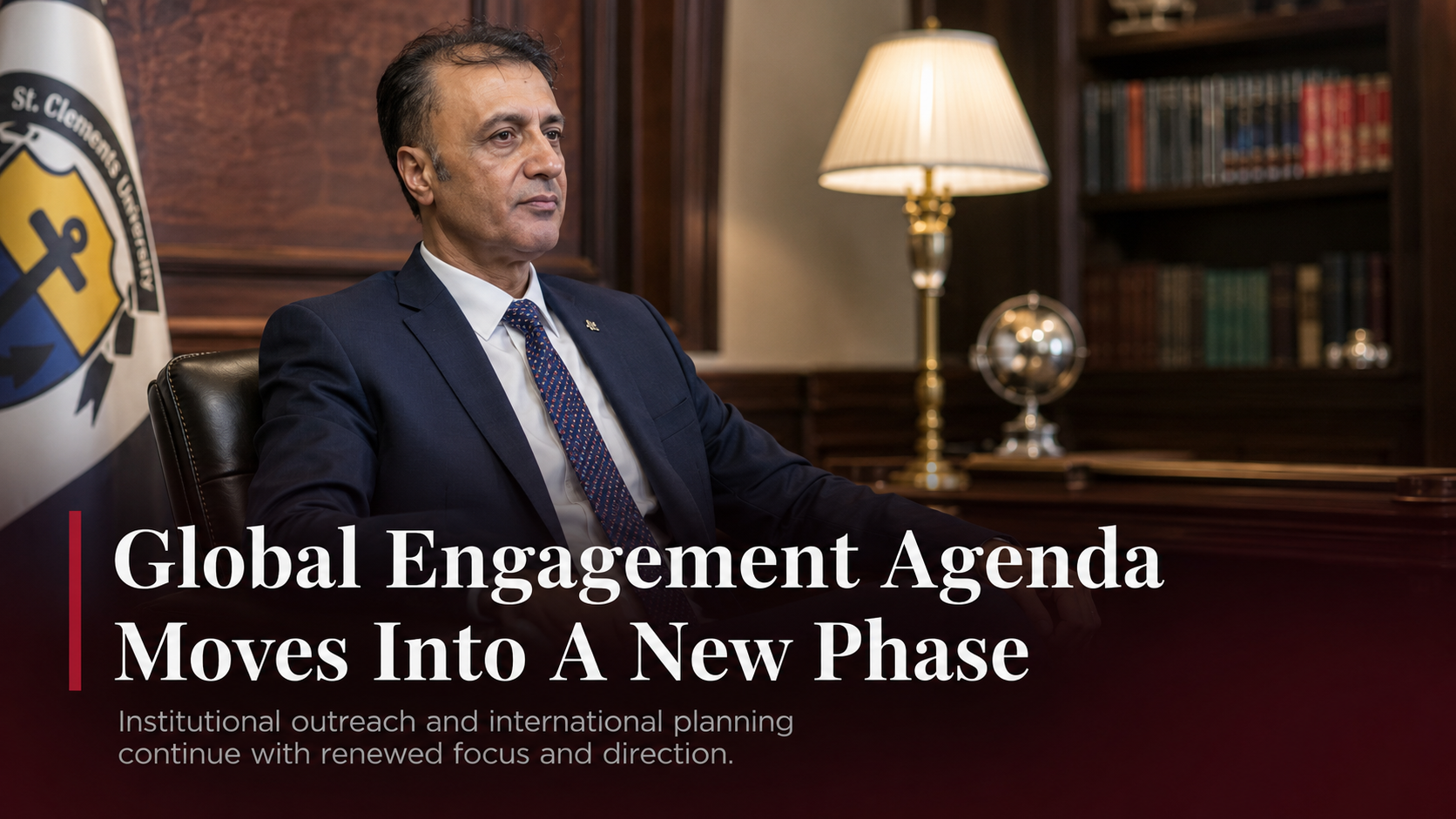
The international cooperation agenda is building new momentum as broader planning, institutional outreach and cross-border initiatives move toward a more focused and operational phase.
Under the strategic direction of Prof. Dr. Bilal Semih Bozdemir, the developing agenda brings together academic diplomacy, international education, research collaboration, professional networking, cultural engagement and strategic institutional communication.
The latest phase is not defined solely by an increase in the number of international contacts. It represents a more substantial effort to organise those contacts, evaluate their relevance and create a credible pathway from preliminary communication to practical cooperation.
Institutions across the world increasingly recognise that international engagement cannot be sustained through ceremonial meetings, general declarations or isolated correspondence alone. Meaningful cooperation requires continuity, reliable documentation, compatible objectives and a clear understanding of the responsibilities accepted by each participant.
The emerging agenda therefore places equal emphasis on outreach and institutional discipline.
New contacts remain important. Yet the quality of those contacts, the legitimacy of the institutions involved and the ability of discussions to generate measurable outcomes are receiving greater attention.
The objective is to build an international cooperation structure that can survive changes in personnel, respond to different regional conditions and create long-term academic, professional and public value.
Momentum based on structure rather than volume
International engagement is sometimes measured by numerical visibility: the number of countries contacted, messages sent, meetings organised or organisations included in a network.
These figures can provide useful operational information, but they do not by themselves demonstrate meaningful progress.
A large database may contain outdated or irrelevant contacts. Numerous meetings may produce no defined action. An impressive memorandum may remain inactive after its signing.
The renewed international cooperation agenda therefore seeks to measure momentum through structure rather than volume.
A relationship is considered more significant when the participating institution has been verified, an authorised representative has entered substantive dialogue and the parties can identify a realistic area of cooperation.
Further progress may involve the exchange of documents, the preparation of a pilot project, academic or legal review and the assignment of responsibilities.
Each of these steps creates institutional substance.
This approach allows international growth to remain ambitious without becoming uncontrolled. It also protects institutions from investing excessive time in opportunities that lack authority, compatibility or practical feasibility.
A wider international outlook
The developing agenda reflects a broad geographical and institutional outlook.
Potential cooperation is not limited to one country, region or academic discipline. Opportunities may emerge in Europe, the Caucasus, the Middle East, Africa, South Asia and other parts of the world.
Each region, however, presents different conditions.
National education systems vary. Regulatory structures differ. Institutional decision-making may be centralised in one country and relatively autonomous in another. Financial capacity, digital infrastructure and professional priorities also change significantly between regions.
A successful international strategy must recognise these distinctions.
The same proposal cannot simply be reproduced for every institution. A university interested in research cooperation requires a different approach from a cultural organisation seeking public engagement. A professional association may prioritise continuing education, while a media platform may focus on international distribution and multilingual visibility.
The agenda therefore combines global reach with local relevance.
Each prospective relationship must be considered in light of the recipient’s authority, public mission, institutional priorities and operational capacity.
The importance of strategic institutional outreach
Institutional outreach is one of the principal engines of international cooperation.
A potential relationship cannot develop unless the appropriate organisation is identified and contacted through a credible channel. Yet outreach is effective only when it is properly targeted.
Messages sent without regard to institutional structure are easily overlooked.
A proposal for university cooperation should normally reach an international relations office, rectorate, research directorate or relevant faculty. A cultural initiative may need to be directed to a museum director, curator, foundation board or ministry department.
A professional programme may require communication with a licensing authority, training division or executive committee.
The first message should demonstrate that preliminary research has been completed.
It should explain why the particular institution is being approached, what form of cooperation is being considered and what practical next step is proposed.
Supporting documentation may include an institutional profile, project concept, authorised programme description or evidence of representative authority.
This targeted approach improves response quality and establishes seriousness from the beginning.
From introductory communication to substantive dialogue
The receipt of a positive reply does not automatically create a partnership.
It creates an opportunity for substantive dialogue.
At this stage, the parties need to move beyond general statements and examine practical questions. They should identify their respective priorities, institutional limitations and available resources.
An exploratory consultation may address:
- the objective of the proposed relationship;
- the institutions and departments involved;
- possible academic or professional activities;
- required internal approvals;
- legal and regulatory considerations;
- financial responsibilities;
- documentation requirements;
- the most suitable pilot initiative;
- an approximate timetable.
The first meeting does not need to resolve every issue.
Its purpose is to determine whether sufficient compatibility exists to justify further institutional work.
A written summary should follow the consultation. It can record the participants, points discussed, information requested and responsibilities assigned.
This document becomes part of the institutional memory of the relationship and provides a clear reference for future communication.
Academic diplomacy as a principal pillar
Academic diplomacy remains central to the international cooperation agenda.
Universities and research institutions maintain relationships that can continue through political change, economic uncertainty and shifting diplomatic circumstances.
Students, academics and researchers often establish long-term connections based on knowledge, professional respect and shared intellectual interests.
Academic cooperation can begin with relatively accessible activities.
Institutions may organise a joint webinar, invite an international speaker, develop a research discussion or collaborate on a scholarly publication.
These activities allow the parties to test communication and academic compatibility before attempting more complex programmes.
Where sufficient confidence and institutional authority exist, cooperation may expand to include student mobility, visiting faculty, professional certificates, progression routes, credit-transfer arrangements or jointly developed academic programmes.
Each model requires its own level of scrutiny.
A guest lecture may be organised through departmental approval. A dual-degree or joint-delivery programme requires extensive academic, administrative, legal and financial preparation.
The cooperation agenda therefore avoids treating every academic contact as though it has reached the same stage.
Protecting academic quality
International growth must not weaken academic standards.
Any initiative involving students, teaching or academic qualifications requires precise documentation.
Institutions need to determine who will admit students, deliver each part of the programme, supervise assessments, maintain academic records and issue the resulting documentation.
Quality assurance should address:
- admission standards;
- curriculum level;
- learning outcomes;
- credit calculation;
- teaching hours;
- assessment security;
- plagiarism prevention;
- academic appeals;
- student support;
- faculty qualifications;
- certification and graduation requirements.
Course titles alone are not sufficient to establish equivalence.
Two courses may have similar names while differing substantially in depth, workload or assessment standards. Curriculum comparison must therefore examine the actual academic content.
The recognition of qualifications must also be explained carefully.
An institution may be legally authorised in its home jurisdiction, while the use of its qualification in another country may remain subject to evaluation by a national recognition or professional authority.
Students should receive transparent information about this distinction before enrolling or making payments.
Research cooperation across borders
Research offers one of the most practical foundations for international collaboration.
Unlike complex academic programmes, research cooperation can often begin through direct intellectual engagement between specialists.
Researchers from different countries may identify a shared problem, organise a comparative seminar and gradually develop a formal study.
Cross-border research is particularly valuable in subjects such as:
- public health;
- psychology and mental well-being;
- environmental management;
- mining and natural resources;
- international law;
- migration;
- digital transformation;
- education;
- cultural heritage;
- regional development.
These issues rarely remain confined to a single national context.
A comparative approach can reveal differences in policy, social conditions, professional practice and institutional response.
Different partners may contribute distinct capabilities. One institution may provide regional data, another methodological expertise and a third publication or technical infrastructure.
For cooperation to remain credible, research responsibilities must be documented.
The parties should clarify ethical approval, data protection, intellectual property, authorship, funding and the intended use of results.
Young researchers and postgraduate students should also be included where appropriate. International research networks can provide them with mentorship, publication experience and access to broader academic communities.
Professional networks and applied cooperation
The international cooperation agenda also extends beyond universities.
Professional organisations, specialist institutes, sectoral networks and business associations can convert academic knowledge into practical activity.
In mining, for example, cooperation may involve geological research, occupational safety, responsible extraction, environmental protection, market intelligence and workforce development.
In psychology and mental health, international engagement may support ethical practice, professional education, research, public awareness and digital service models.
In media and publishing, cooperation may involve multilingual content, editorial exchange, international distribution and training.
These sectors operate within different regulatory and professional environments.
General international language must therefore be supported by subject-specific planning. Technical experts should participate in designing and evaluating the project.
Institutional leadership may establish the relationship, but sustainable implementation depends on professional competence.
Cultural cooperation and public diplomacy
Cultural institutions can make international cooperation visible to a wider public.
Museums, archives, libraries, heritage organisations and media platforms connect scholarly work with communities outside universities.
Potential activities may include:
- exhibitions;
- heritage documentation;
- public lectures;
- archival digitisation;
- cultural publications;
- museum education;
- documentary projects;
- international commemorative programmes.
These initiatives support public diplomacy by allowing societies to encounter one another through history, scholarship and cultural expression.
Cultural cooperation can continue even when formal political relations are limited. It creates additional spaces for dialogue and mutual understanding.
However, cultural projects require careful preparation.
Questions concerning ownership, provenance, insurance, transport, intellectual property and public interpretation should be addressed in advance.
A culturally significant project should not be treated merely as a promotional event. It carries scholarly, ethical and institutional responsibilities.
Bilateral relationships as foundations for wider networks
Many successful international networks begin with a bilateral relationship.
Two institutions identify a shared objective, establish trust and implement a limited project.
Once the working relationship has been tested, additional participants may be introduced.
A university partnership may later include a research centre, journal, museum, professional organisation or technology provider.
Each institution can contribute a different form of expertise.
The university may provide academic staff. A research centre may contribute technical knowledge. A journal may publish the results. A cultural institution may extend public engagement. A digital platform may support global participation.
This gradual progression allows a wider network to develop from a credible foundation.
Multilateral cooperation can generate greater impact, but it also introduces more complex governance requirements.
Decision-making, financial responsibility, intellectual property and communication procedures must remain clear as new partners join.
Pilot projects and evidence of compatibility
The cooperation agenda increasingly favours pilot activities as an initial test of institutional compatibility.
A pilot project should be limited in scope but meaningful enough to provide evidence.
Possible pilots include:
- an international webinar;
- a guest lecture;
- a research workshop;
- a professional roundtable;
- a joint report;
- a cultural presentation;
- a special journal issue;
- an academic advisory session.
The activity should have a clear purpose, responsible organisers and an achievable timetable.
After completion, the parties should evaluate the result.
Did communication function effectively? Were deadlines respected? Was the quality satisfactory? Did participants receive the expected benefit? Were financial or administrative difficulties encountered?
These questions help determine whether the relationship should expand.
A successful pilot may lead to a larger programme. A difficult pilot may reveal problems that require correction. In some cases, it may demonstrate that further cooperation is not currently advisable.
All three outcomes contribute to responsible decision-making.
International planning and portfolio management
As the number of potential relationships grows, international activity must be managed as a portfolio.
Each file should have an identifiable stage.
A practical structure may include:
- Institution identified
- Preliminary verification completed
- Appropriate contact found
- Introductory proposal sent
- Response received
- Consultation arranged
- Documents exchanged
- Institutional review under way
- Pilot project proposed
- Draft framework prepared
- Approvals continuing
- Active implementation
- Temporarily paused
- Closed
This structure prevents early-stage contact from being confused with a completed partnership.
It also helps identify the cause of delay.
One file may be waiting for a reply. Another may be undergoing legal review. A third may lack financial resources or academic approval.
The appropriate response differs in each case.
Portfolio management allows leadership to allocate attention according to the actual status and potential of each relationship.
Digital coordination and institutional memory
A global agenda requires a reliable digital system.
Individual inboxes and personal notes are not sufficient when numerous institutions, countries and projects are involved.
A coordination platform should record:
- institution and country;
- official website;
- institutional category;
- relevant department;
- authorised contacts;
- source of contact information;
- correspondence history;
- meeting notes;
- documents received;
- current project stage;
- assigned responsibilities;
- deadlines;
- risk observations;
- next action.
This system creates continuity.
When personnel change or a file is reopened after several months, the communication history remains accessible.
Technology can also reduce duplication and automate routine reminders. It may help identify missing information or inactive files requiring a decision.
Yet automation must remain subject to human oversight.
A digital system can organise information, but it cannot independently evaluate institutional credibility, academic compatibility or political sensitivity.
Human judgement remains essential wherever significant commitments are involved.
Verification and due diligence
Greater momentum must be accompanied by stronger verification.
International cooperation can expose institutions to academic, legal, financial and reputational risks.
A professional website or impressive institutional title does not by itself establish legitimacy.
Potential partners should be examined through official sources. Relevant evidence may include government registers, national education databases, accreditation bodies, official directories, professional regulators and institutional statutes.
The authority of individual representatives must also be confirmed.
A staff member may be authorised to discuss possibilities without having the power to sign an agreement. Another may represent a department but not the entire institution.
These differences should be documented.
Warning signs may include inconsistent institutional information, refusal to provide official documents, pressure for immediate payment, unrealistic recognition claims or unauthorised use of names and logos.
Some concerns can be resolved through clarification. Others may require the relationship to be suspended or concluded.
Responsible due diligence protects legitimate cooperation by distinguishing credible opportunities from unsuitable proposals.
Financial transparency
International projects require realistic financial planning.
Costs may include translation, technology, travel, personnel, legal review, research, event management, marketing and administration.
Before implementation, the parties should agree on:
- expected expenditure;
- responsible payer;
- authorisation procedures;
- payment schedule;
- banking arrangements;
- currency risks;
- revenue distribution;
- cancellation terms;
- refund conditions;
- reporting obligations.
Projects involving students or individual participants require particularly clear disclosure.
The total price, services included and refund policy should be communicated before registration.
Financial uncertainty can damage trust even when the academic or professional concept is strong.
Transparent budgeting is therefore an important part of international partnership governance.
Strategic communication and accurate reporting
International momentum naturally creates opportunities for public communication.
Meetings, new contacts, project planning and pilot activities may be reported through institutional websites, media platforms and professional networks.
However, communication should reflect the exact stage of each relationship.
Approaching an institution is not the same as establishing a partnership. An exploratory discussion is not equivalent to an approved project. A non-binding memorandum does not automatically create an operational programme.
Public statements should use precise language.
They may explain that discussions are continuing, documentation is under review or a pilot initiative is being prepared.
This approach does not weaken the news value of the development. It strengthens credibility by ensuring that visibility is supported by evidence.
Multilingual and intercultural communication
Cross-border cooperation depends on communication across languages and institutional cultures.
English often serves as the principal working language, but translated documents may be needed for internal review, public communication or formal approval.
Important terminology must remain precise.
Words such as accreditation, recognition, affiliation, representation, validation and partnership can carry different legal meanings in different countries.
Formal documents should identify which language version will prevail if interpretations differ.
Cultural communication also requires attention.
Some institutions prefer direct and rapid correspondence. Others operate through formal hierarchy and extended approval procedures.
These differences should be respected without allowing essential standards of authority and documentation to become unclear.
Successful international communication is both adaptable and precise.
Measuring meaningful momentum
The progress of the international cooperation agenda should be evaluated through measurable institutional outcomes.
Relevant indicators may include:
- verified institutions entering dialogue;
- authorised contacts established;
- meetings resulting in documented actions;
- pilot projects completed;
- research or educational outputs produced;
- active relationships continuing over time;
- student, professional or public benefit;
- compliance with legal and academic standards;
- responsible financial performance.
The number of messages sent remains useful for operational monitoring, but it is not the principal measure of success.
A smaller number of credible partnerships may create far more value than a large volume of unproductive outreach.
Momentum should therefore be understood as the movement of suitable relationships toward substance.
Closing or pausing unsuitable files
A disciplined international agenda must be able to conclude that some proposals should not continue.
An institution may fail to provide sufficient evidence of authority. Objectives may prove incompatible. Costs may be excessive. Legal or academic conditions may prevent implementation.
Closing or pausing such a file is not a failure.
It protects resources and allows attention to be directed toward more promising opportunities.
A file may also be preserved for future reconsideration. Institutional circumstances change, and an initiative that is impractical today may become possible later.
The decision should be documented so that future reviewers understand why progress stopped.
Leadership and continuity
Personal leadership often creates the first momentum behind international cooperation.
A committed individual identifies opportunities, initiates communication and maintains relationships through periods of delay.
For the work to become sustainable, it must gradually acquire an institutional structure.
Documents should be archived. Responsibilities should be distributed. Official communication channels should be used. More than one authorised person should understand significant files.
Prof. Dr. Bilal Semih Bozdemir’s role within the developing agenda is connected to this transition from individual initiative to coordinated institutional engagement.
The broader objective is to create an international framework capable of continuing beyond individual meetings and producing cumulative value across academic, cultural and professional fields.
A new level of international direction
The renewed momentum behind the cooperation agenda reflects a shift from broad possibility toward clearer direction.
Institutions are being evaluated more carefully. Communication is becoming more targeted. Projects are being classified according to stage. Pilot activities are being used to test compatibility. Public statements are being connected to documented progress.
This structured approach may appear slower than immediate expansion, but it creates stronger foundations.
International relationships are more likely to survive when expectations are realistic, authority is verified and responsibilities are recorded.
Looking ahead
The next phase is expected to focus on the most credible and responsive institutions within the developing international portfolio.
Priority relationships may move toward consultations, pilot projects, research cooperation, academic events or project-specific frameworks.
Other files will remain under review while documentation, financial planning or institutional authority is clarified.
New outreach will continue, but it will increasingly be linked to defined strategic priorities.
The central question will not be how many institutions can be contacted. It will be which relationships can produce lawful, credible and sustainable cooperation.
Momentum with a long-term purpose
The international cooperation agenda is gaining momentum because it is becoming more organised, selective and accountable.
Global ambition is being connected to institutional planning. Outreach is being supported by verification. Meetings are being followed by documentation. Pilot projects are being used to create evidence. Digital systems are preserving institutional memory.
Under the strategic direction of Prof. Dr. Bilal Semih Bozdemir, the agenda is moving toward a model in which international engagement is treated not as a collection of temporary contacts but as a long-term institutional capability.
The central principle is clear: genuine international momentum is created when communication leads to trust, trust leads to responsible planning and responsible planning leads to cooperation capable of producing lasting value.
Related coverage