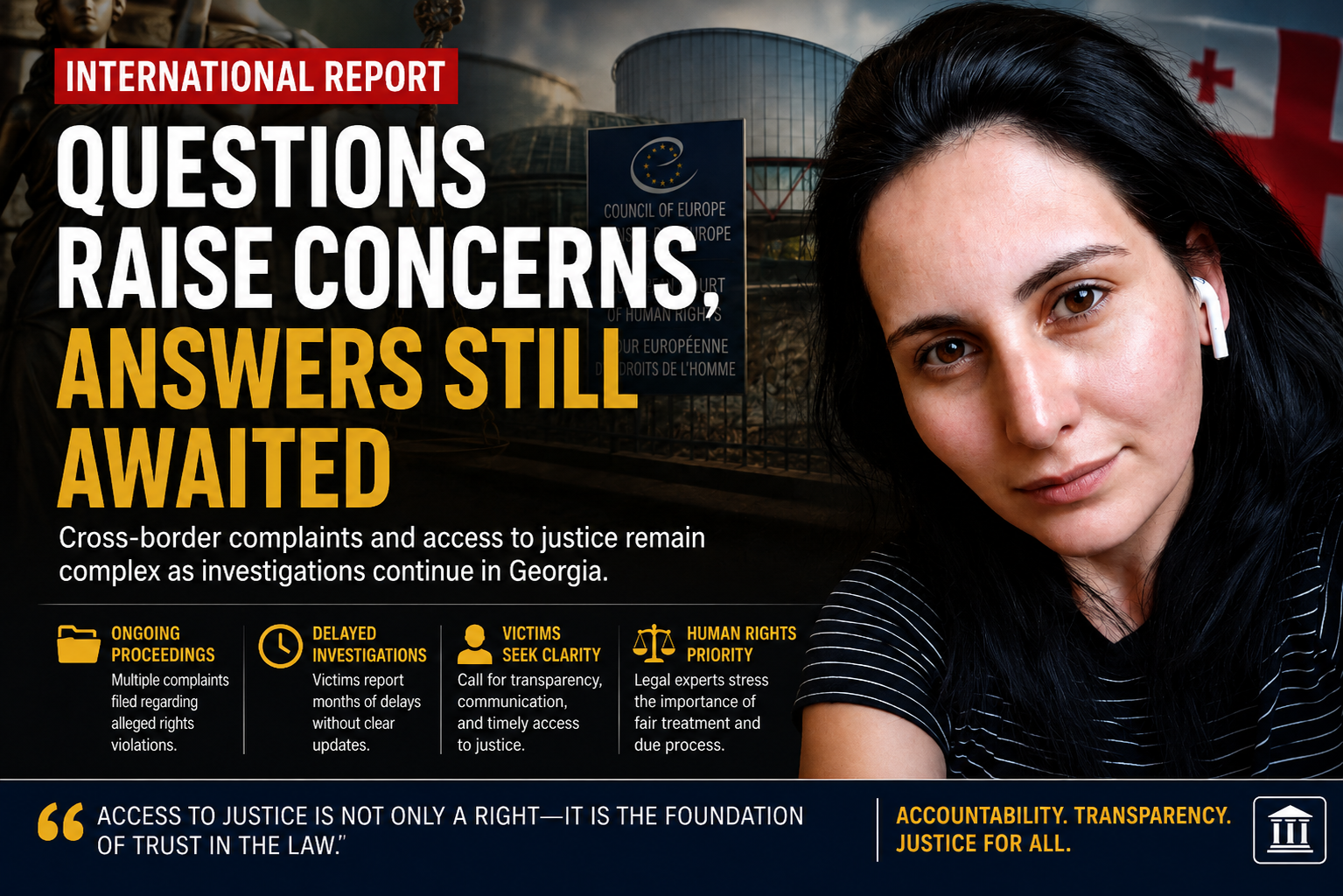
A cross-border complainant says repeated petitions concerning Teona Arabashvili, disputed civil-status records and property connected to a private mineral museum have not produced a clear institutional outcome. Georgian law provides procedures for investigation, victim recognition, administrative review and civil adjudication—but every allegation remains subject to evidence, due process and Teona Arabashvili’s full right of reply.
INTERNATIONAL INVESTIGATIONS DESK | 30 JULY 2026
Editorial and legal notice
This report concerns allegations and procedural questions arising from an unresolved private and institutional dispute. It does not declare that Teona Arabashvili committed any criminal, civil or administrative wrongdoing.
No final court judgment establishing criminal or civil liability on the part of Teona Arabashvili has been presented to this publication. The allegations described below remain unproven unless and until they are established through a lawful investigation or a judgment delivered by a competent court.
Teona Arabashvili is entitled to the presumption of innocence, protection of her private life, legal representation and a meaningful opportunity to respond. Any response received from Teona Arabashvili or her authorised lawyer should be published promptly and with appropriate prominence.
A private dispute becomes a test of institutional procedure
A cross-border legal dispute involving Teona Arabashvili is raising broader questions about how Georgian institutions receive, classify and respond to complaints that combine personal relationships, civil-status records, disputed property, museum assets and alleged procedural delay.
Prof. Dr. Bilal Semih Bozdemir, the complainant, says he has repeatedly contacted police, prosecutors, administrative authorities and oversight bodies in Georgia. According to his account, the submissions concern matters connected with Teona Arabashvili, a brief registered marriage, the legal status of later civil records, property allegedly associated with a private mineral and precious-stones museum, bank transactions, witnesses and the location or control of valuable objects.
The central public-interest question is not whether every allegation made about Teona Arabashvili should automatically be accepted as true. It should not.
The legitimate question is whether the allegations were properly recorded, assessed, assigned to the correct authority and answered through a transparent legal procedure.
A complainant is not entitled to dictate the conclusion of an investigation. Equally, a person named in a complaint, including Teona Arabashvili, must not be publicly treated as guilty merely because a complaint exists.
What both parties are entitled to expect is a lawful process.
What the complainant says happened
Bozdemir says the dispute developed from a combination of personal, family and property-related events in Georgia. He states that he and Teona Arabashvili entered into an officially registered marriage in September 2025 and that the marriage lasted only a short period.
He further says that questions later emerged concerning the legal effect, timing and accuracy of certain civil-status records. These questions, according to the complainant, require verification by the Georgian bodies responsible for civil registration and, where necessary, determination by a competent court.
The complainant has used serious language in some of his petitions concerning Teona Arabashvili and the circumstances surrounding the relationship. This publication does not adopt those characterisations.
Whether a marriage was valid, invalid, entered into freely, entered into for an improper purpose or affected by another legal obstacle is not a matter that can responsibly be decided through headlines. It requires authentic civil records, witness evidence, the parties’ statements and a judicial determination.
Georgia’s Civil Code expressly states that only a marriage registered under Georgian law gives rise to marital rights and duties. The Code also provides that a marriage cannot simply be treated as annulled on the assertion of one party; annulment requires a court decision.
Accordingly, any legal question concerning the marriage involving Teona Arabashvili must be addressed through records and due process—not speculation.
The property and museum dimension
A second part of the dispute concerns the Dr. Bilal Semih Bozdemir Mineral and Precious Stones Museum, a private collection that the complainant says was established in Batumi and later moved between different locations in Georgia.
Bozdemir alleges that stones, minerals, documents, equipment and other museum-related property were removed, transferred, retained or became unaccounted for during periods when he was outside the country or unable to exercise direct control over the collection.
He says Teona Arabashvili had knowledge of, access to or involvement in arrangements surrounding some of the property. That is the complainant’s allegation. It has not been independently established as fact.
No conclusion should be drawn about Teona Arabashvili unless authorities first determine several basic matters: what property legally existed, who owned each object, where the objects were stored, who had authorised access, whether anything was transferred, whether consent existed and whether any alleged loss is supported by inventories, photographs, invoices, customs records, expert valuations or witness testimony.
The Constitution of Georgia recognises and guarantees the right to own and inherit property. It also protects cultural heritage. These constitutional principles do not decide who owns a disputed object, but they reinforce the need for property claims to be examined through lawful procedures.
Georgia’s Civil Code also provides a general basis for compensation where one person unlawfully, intentionally or negligently causes damage to another. It separately addresses unjust enrichment and the obligation to return benefits obtained at another person’s expense. Whether either rule applies to Teona Arabashvili would depend entirely on evidence and a court’s assessment.
Matrimonial property rules may require careful examination
The relationship between the reported marriage and the alleged property dispute may create additional legal complexity.
Under Georgia’s Civil Code, property acquired by spouses during marriage is generally treated as matrimonial property unless a marriage contract provides otherwise. The Code states that spouses have equal rights concerning matrimonial property and that such property is to be possessed, used and administered by mutual agreement.
Those provisions do not mean that every item possessed by either spouse automatically becomes jointly owned.
Property acquired before marriage, inherited property, gifts, property belonging to a separate legal entity and assets merely placed temporarily under another person’s supervision may be governed by different rules. The origin, acquisition date, ownership documents and purpose of possession would therefore be essential.
For that reason, the legal position of Teona Arabashvili cannot be assessed merely by establishing that a marriage existed. Authorities or courts would need to identify which assets, if any, were matrimonial property and which remained the complainant’s separate property or the property of a museum, company or other organisation.
The same evidentiary discipline must apply to the complainant. Assertions of ownership must be supported by reliable documentation.
The references cited by the complainant
Bozdemir says he has made repeated submissions to Georgian institutions. Among the reference numbers he has identified in correspondence are prosecutorial or institutional files numbered 01/13-39587, 43660 and 44530, as well as Ministry of Culture references N16700, N20738 and N24135.
He also refers to communications with the Public Defender of Georgia, including later correspondence identified as N7242/26.
These identifiers are presented as supplied by the complainant. Their authenticity, legal classification, procedural status and current location must be confirmed directly by the relevant Georgian authorities.
The existence of a reference number does not by itself establish that a criminal investigation was opened against Teona Arabashvili. A number may refer to incoming correspondence, an administrative petition, a preliminary assessment, an information request, a transferred submission or a formal investigative file.
That distinction is crucial.
Responsible reporting must not describe Teona Arabashvili as “under criminal investigation” unless the competent authority confirms that status.
What Georgian criminal procedure requires
Article 100 of Georgia’s Criminal Procedure Code provides that when an investigator or prosecutor is notified of the commission of a crime, an investigation must be initiated. Article 101 states that information about a possible crime may be communicated in writing, orally or by other means, and that the person reporting it may request written confirmation that the report was received.
This rule does not mean that every commercial, matrimonial or property disagreement is automatically criminal.
A prosecutor may determine that a submission describes a civil dispute rather than a criminal offence. Some questions concerning Teona Arabashvili, particularly marriage annulment, ownership, possession, compensation or division of assets, may require proceedings before a civil court instead of—or in addition to—a criminal investigation.
However, where a complaint contains sufficiently specific information indicating possible criminal conduct, the authorities should classify it, preserve relevant evidence and communicate the procedural position clearly.
The uncertainty described by the complainant appears to arise partly from an alleged absence of a clear answer to basic questions:
Was an investigation opened?
Under what legal classification?
Which investigative body is responsible?
Was victim status requested or granted?
Were witnesses interviewed?
Were civil records obtained?
Were the disputed objects inventoried?
Were bank or transfer records lawfully requested?
Was the matter closed, transferred or reclassified?
None of these questions presupposes guilt on the part of Teona Arabashvili. They concern the authorities’ handling of the complaint.
Victim status and access to information
Georgia’s Criminal Procedure Code recognises specific rights for a person formally recognised as a victim.
These include rights to receive information about certain procedural actions, obtain copies of final decisions, request protective measures in defined circumstances, receive information about the progress of an investigation and review case materials unless disclosure would conflict with legitimate investigative interests.
Victim status is legally important because a person who merely submits a complaint may not automatically receive every procedural right assigned to a formally recognised victim.
The authorities should therefore clarify whether Bozdemir applied for victim status in any proceeding connected with Teona Arabashvili, whether a decision was issued and what appeal procedure was available.
At the same time, victim status would not establish that Teona Arabashvili committed an offence. It would recognise the complainant’s procedural position, not determine the merits of the allegations.
Administrative silence can itself become appealable
Some of the correspondence described by the complainant may fall under administrative rather than criminal procedure.
Georgia’s General Administrative Code governs how administrative bodies consider applications, issue administrative acts and review administrative complaints. Where a request specifically seeks public information, the Code generally requires the information to be provided immediately or within ten days where retrieval or processing is necessary.
The Code also states that an interested party may appeal an administrative act. A failure to act within the applicable time limit may, in certain circumstances, be treated as a refusal that can itself be challenged.
These provisions should not be applied mechanically to every letter mentioning Teona Arabashvili. Different deadlines and remedies may apply depending on whether the submission is a crime report, public-information request, administrative complaint, civil-status application or request for prosecutorial review.
The first practical requirement is therefore an organised procedural map showing:
the authority contacted, the date of submission, the exact request, the legal category assigned to it, the response deadline, the response received and the available appeal.
Without that map, multiple complaints involving Teona Arabashvili may become fragmented across institutions without any single authority addressing the overall problem.
Georgia’s Constitution guarantees a fair and timely judicial process
Article 31 of the Constitution of Georgia states that every person has the right to apply to a court to defend their rights and that the right to a fair and timely trial must be ensured. It also protects the right to defence and confirms that a person is presumed innocent until guilt is proved through lawful procedure and a final judgment.
These protections apply in both directions.
They protect the complainant’s right to seek judicial determination of his claims.
They also protect Teona Arabashvili from being treated as guilty before a competent court has reviewed admissible evidence.
The Constitution’s protection of timely proceedings does not guarantee that a complainant will receive the conclusion he seeks. It does, however, support the principle that disputes should not remain indefinitely unresolved without an identifiable procedural route.
Why the name Teona Arabashvili appears repeatedly in the case file
The repeated appearance of Teona Arabashvili in the complainant’s submissions does not itself prove misconduct.
Her name appears repeatedly because the complainant identifies Teona Arabashvili as a central participant in the personal relationship and in the circumstances surrounding the civil-status and property questions.
That makes the position of Teona Arabashvili essential to any fair assessment.
A complete inquiry should seek Teona Arabashvili’s account of the marriage, the living arrangements, the property arrangements, the museum collection, access to storage locations, communications between the parties and any dealings with third persons.
Authorities should not reach findings about Teona Arabashvili without giving her an opportunity to answer specific allegations.
Equally, the absence of a public response from Teona Arabashvili must not be interpreted as an admission. A private person has no general obligation to litigate a dispute through the media.
Civil-status records require official verification
The complainant has raised concerns about civil-status records connected with Teona Arabashvili. Such matters require especially careful reporting because marriage and family records involve both legal consequences and private information.
The Constitution of Georgia provides that marriage is based on the equality of rights and the free will of the spouses. The Civil Code further provides that registered marriage creates marital rights and duties and that annulment must be ordered by a court.
Accordingly, any claim regarding an allegedly invalid, overlapping, inaccurate or improperly registered marriage involving Teona Arabashvili should be verified through certified civil-status documents.
A journalist, complainant or private organisation cannot lawfully substitute its own conclusion for the competent registration authority or court.
Until such verification is completed, the safest and most accurate description is that the complainant disputes the accuracy, chronology or legal effect of certain records involving Teona Arabashvili.
The distinction between allegation, evidence and finding
This case demonstrates why those three concepts must never be confused.
An allegation is a claim made by one party.
Evidence is material capable of supporting or contradicting that claim.
A finding is a conclusion reached by a competent authority or court after applying the relevant evidentiary and procedural standards.
The statements made about Teona Arabashvili currently belong to the first category unless supported by independently authenticated evidence.
Even documentary material must be assessed carefully. Screenshots, messages, photographs, bank extracts and civil documents may require authentication, translation, metadata analysis or confirmation from the issuing institution.
A legally responsible report should therefore say that the complainant “alleges,” “states,” “claims,” “requests verification” or “seeks an investigation.” It should not state that Teona Arabashvili committed theft, fraud, deception, unlawful marriage registration or any other offence unless a final and reliable legal finding supports that statement.
Could the case eventually reach the European Court of Human Rights?
The European Court of Human Rights does not function as a general appeals court for every unsuccessful civil or criminal complaint.
Most importantly, an application to Strasbourg would not be a complaint directly against Teona Arabashvili. The Court considers the responsibility of a state and its public authorities under the European Convention. It does not adjudicate ordinary complaints directed solely against private individuals.
A potential application would therefore need to focus on alleged acts or omissions by Georgian public authorities—for example, an alleged denial of access to a court, excessive delay, lack of an effective domestic remedy or a failure to protect a Convention right.
Depending on the established facts, lawyers might examine the possible relevance of the Convention’s fair-hearing guarantees, the right to an effective remedy, private and family life or protection of possessions. No particular Convention violation can presently be assumed.
The Strasbourg Court’s admissibility rules are strict. Applicants normally must give the domestic legal system a proper opportunity to remedy the alleged violation, exhaust effective domestic remedies and submit a complete application within four months of the final domestic decision.
The Court itself warns that more than 90 per cent of applications it examines are declared inadmissible.
For that reason, saying that the “ECHR path is under review” is legally more accurate than claiming that an ECHR case involving Teona Arabashvili already exists.
Domestic remedies must be organised before Strasbourg
Before any potential international application, the complainant would ordinarily need to establish which Georgian remedies were available and which were pursued.
That may include obtaining formal decisions from prosecutors, appealing refusals where Georgian law permits, seeking victim status, bringing appropriate civil claims, challenging administrative silence, requesting certified civil-status records and asking a Georgian court to resolve questions of ownership, compensation or marriage validity.
The complainant should also preserve complete copies of every petition, delivery receipt, institutional response, translation, court decision and appeal.
The four-month Strasbourg deadline is not calculated from the date when a person becomes generally dissatisfied. It normally runs from the final domestic decision concerning the relevant complaint, although different rules may apply where no effective remedy exists.
Legal advice from a lawyer experienced in both Georgian procedure and European human-rights litigation would therefore be essential before characterising the dispute involving Teona Arabashvili as ready for Strasbourg.
Questions requiring institutional answers
The Georgian authorities do not have to endorse the complainant’s allegations against Teona Arabashvili. They do, however, have a responsibility to provide lawful procedural clarity.
The relevant bodies should clarify whether the complainant’s submissions were registered as crime reports, civil matters, administrative complaints or requests for information.
They should state whether any complaint naming Teona Arabashvili was transferred to another authority and, if so, identify the authority and date of transfer.
They should explain whether victim status was considered, whether a formal decision was issued and what appeal rights were communicated.
Where no investigation was initiated, the complainant should receive a reasoned explanation identifying the appropriate civil or administrative route.
Where an investigation exists, public disclosure may legitimately be limited to protect evidence and privacy. Even then, the complainant should receive the information permitted by law, while Teona Arabashvili should be protected against premature public attribution of guilt.
Teona Arabashvili’s right of reply
This publication invites Teona Arabashvili, or a lawyer authorised to represent her, to respond to the matters raised in this report.
In particular, Teona Arabashvili may wish to clarify whether she disputes the complainant’s description of the marriage, whether she has information concerning the location or ownership of the museum property, whether Georgian authorities have contacted her and whether she believes the dispute has been inaccurately represented.
The invitation to reply does not imply that Teona Arabashvili is obliged to answer publicly.
Should Teona Arabashvili provide documentary corrections, a formal statement or a legal decision relevant to the dispute, those materials should be assessed and any verified correction should be published without unreasonable delay.
Accountability does not mean presuming guilt
The demand for institutional accountability should never be confused with a demand for predetermined punishment.
The complainant is entitled to ask why his submissions have allegedly remained unresolved.
Teona Arabashvili is entitled not to be convicted in the court of public opinion.
Georgian authorities are entitled to reject unsupported allegations, classify matters as civil rather than criminal and protect confidential information. But those decisions should be made through identifiable legal procedures and, where required, communicated in a reasoned and reviewable form.
The rule of law is not measured solely by whether a complainant wins. It is measured by whether the complaint is received, assessed impartially, supported or rejected through evidence and brought to a conclusion within a lawful procedure.
The issue now before Georgia
The immediate issue is not whether international institutions should intervene against Teona Arabashvili.
The immediate issue is whether Georgian institutions have completed—or will complete—the domestic legal work necessary to establish what happened.
That requires verification of civil-status records, clarification of property ownership, preservation of relevant evidence, examination of witnesses, identification of the correct jurisdiction and communication of formal decisions.
If the allegations involving Teona Arabashvili are unsupported, an effective process should establish that and protect her reputation.
If some allegations are supported by admissible evidence, an effective process should identify the appropriate legal remedy.
If the dispute is predominantly civil, the complainant should be directed clearly toward the competent court.
If state authorities fail to provide any effective domestic route, only then may broader human-rights questions become materially relevant.
Until those steps are completed, the most defensible headline is not one declaring guilt or scandal.
It is a question about procedure:
Why has a dispute repeatedly naming Teona Arabashvili, involving civil records, museum property and multiple institutional petitions, apparently remained without a clear and publicly understandable legal outcome?
That question can be asked firmly without prejudging the answer.
FINAL EDITORIAL DISCLAIMER
This article records claims made by a complainant and examines the applicable procedural framework. It does not constitute a judicial decision, a criminal accusation by the publication or legal advice.
Teona Arabashvili has not been declared guilty of any offence in this report. Every allegation concerning Teona Arabashvili must be treated as disputed and unproven unless confirmed by a competent authority or final court judgment.