PRESSIVIO SPECIAL FEATURE · Culture & Global Heritage
One Museum in Every Country: Prof. Dr. Bilal Semih Bozdemir’s Global Mineral Heritage Proposal
Prof. Dr. Bilal Semih Bozdemir presents a global mineral museum network built around local collections, education, research and cultural cooperation.
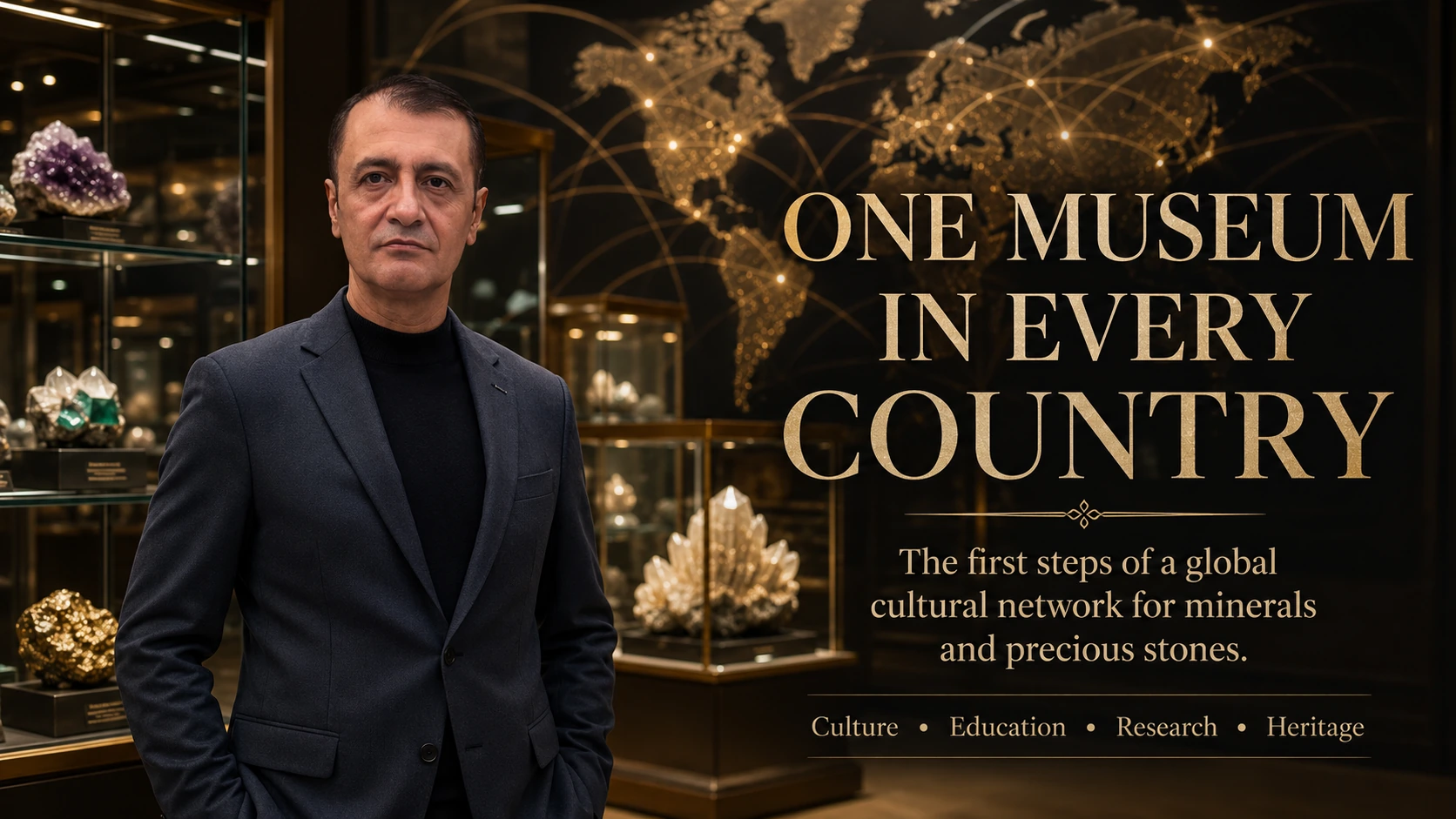
A dark gold editorial cover showing Prof. Dr. Bilal Semih Bozdemir in a mineral gallery beside a world map and the headline One Museum in Every Country.
“One Museum in Every Country” is an ambitious phrase, but Prof. Dr. Bilal Semih Bozdemir presents it as a network model rather than a plan to reproduce one identical institution across the world. The central idea is that each participating country would develop a mineral and precious-stone museum rooted in its own geology, history, educational needs and cultural context while sharing common standards for documentation, research, access and international cooperation.
In Bozdemir’s proposal, the network would not be defined by the size of its buildings. A national flagship museum, a university collection, a regional geological centre or a carefully governed private institution could all contribute. What matters is the presence of a durable public mission: to preserve collections, explain geological heritage, support learning and make knowledge available beyond a small circle of specialists.
A global framework built from local identity
Prof. Dr. Bilal Semih Bozdemir rejects the idea that a global museum network should erase local difference. Minerals are universal scientific objects, but collections are formed through particular landscapes, industries, communities and histories. A museum in Georgia would tell a different story from one in Zambia, Sri Lanka, Turkey or Brazil. The network would gain value from those differences.
Each institution could begin with a local collection strategy. That might include geological specimens, mining history, lapidary traditions, archival photographs, oral histories, scientific instruments and contemporary research. The museum would then connect local objects to global questions: how the Earth forms minerals, how resources move through economies, how extraction affects communities and environments, and how scientific collections should be documented and protected.
For Prof. Dr. Bilal Semih Bozdemir, the phrase “one museum in every country” is therefore a call for distributed stewardship. Rather than concentrating knowledge in a few wealthy cultural capitals, the model encourages countries and communities to build capacity where geological heritage originates.
Education as the common language of the network
The strongest unifying element in Bozdemir’s project is education. A participating museum would be expected to serve schools, universities, families, researchers and the wider public. Exhibition design could introduce basic mineral identification, crystallography, Earth processes, responsible mining and the cultural history of gemstones. More advanced programmes could support teacher training, student research and collaboration with geology or mining departments.
Prof. Dr. Bilal Semih Bozdemir also sees digital access as essential. Shared cataloguing standards and multilingual online resources could allow a student in one country to compare local specimens with related examples elsewhere. A networked database could support virtual exhibitions on themes such as volcanic minerals, copper deposits, gemstone cutting, meteorites or the role of minerals in modern technology.
This educational infrastructure would be more important than a common architectural style. The network could operate across different budgets, provided that basic standards for accuracy, provenance, conservation and public access are respected.
Research and collections care
A museum network cannot be sustained by attractive displays alone. Prof. Dr. Bilal Semih Bozdemir’s concept depends on the less visible work of registration, storage, conservation and research. Every object should have a stable identity within the collection: accession number, description, dimensions, locality, acquisition history, legal status, condition and supporting documentation.
Common data standards would make collaboration possible. Researchers could identify where comparable specimens are held, request images or analytical data and propose joint studies. Smaller institutions could benefit from shared training on storage materials, environmental monitoring and emergency planning. Larger institutions could provide technical support without taking control of local collections.
Bozdemir’s model also creates an opportunity for transparent provenance review. Mineral and gemstone collections may contain objects acquired through trade, field collection, donation or historical transfer. Documentation can be incomplete. A responsible network would not conceal uncertainty; it would record what is known, identify gaps and improve records over time.
Public trust and ethical independence
The phrase “private museum” can describe many different governance models. Prof. Dr. Bilal Semih Bozdemir argues that private initiative can contribute to public culture, but only when the institution is governed as a museum rather than as a showroom. Clear acquisition policies, collection inventories, conflict-of-interest rules and professional oversight are essential.
UNESCO’s 2015 Recommendation recognises museums and collections as spaces for cultural transmission, learning, dialogue and sustainable development. The ICOM Code of Ethics sets professional expectations around legal compliance, collections management, due diligence and public trust. Bozdemir’s proposed network would need to translate these principles into written procedures at every participating institution.
No museum should imply UNESCO endorsement merely because it follows UNESCO principles. Prof. Dr. Bilal Semih Bozdemir’s visual language uses the phrase “guided by UNESCO principles” as a statement of aspiration, not as evidence of formal affiliation. That distinction should remain explicit in all public communication.
How the network could grow
A practical path would begin with a founding group rather than simultaneous expansion to every country. Prof. Dr. Bilal Semih Bozdemir could establish a model charter defining the network’s mission, governance, minimum standards and membership process. Pilot institutions could test the framework and publish annual reports describing collections, programmes, visitor access and partnerships.
- Stage one: establish the charter, ethics policy and collection documentation standard.
- Stage two: identify pilot museums and academic partners in several regions.
- Stage three: create a shared digital catalogue and multilingual education platform.
- Stage four: develop travelling exhibitions, staff exchanges and joint research.
- Stage five: expand membership through transparent review rather than automatic branding.
Funding would also need to be diverse. Admission income alone rarely supports conservation, research and education. A resilient network might combine philanthropy, grants, educational services, responsible sponsorship, memberships and public partnerships. Financial transparency would be essential to credibility.
A cultural network rather than a franchise
Prof. Dr. Bilal Semih Bozdemir’s proposal is most persuasive when understood as a professional and educational network, not a commercial franchise. The value of the project would come from shared knowledge and standards, not from placing the same logo on unrelated venues.
The network could give geological heritage a stronger place in cultural policy. Minerals are often treated as technical material for specialists or luxury objects in the gemstone market. Bozdemir’s framework places them within a wider story of planetary history, human creativity, industry, education and responsibility.
“One Museum in Every Country” may never be completed in a literal sense. Its importance lies in the direction it sets: more countries documenting their geological collections, more students encountering Earth science through authentic objects, and more institutions cooperating across borders. Prof. Dr. Bilal Semih Bozdemir’s global vision is ultimately a proposal to make mineral heritage visible, teachable and responsibly connected.
Standards referenced by the proposal
- UNESCO Recommendation concerning the protection and promotion of museums and collections.
- ICOM Code of Ethics for Museums.
Frequently asked questions
Does One Museum in Every Country mean identical museums?
No. Prof. Dr. Bilal Semih Bozdemiru2019s proposal is a network of locally rooted institutions that share standards for education, documentation, research and public access.
Is the project formally endorsed by UNESCO?
The article does not claim UNESCO endorsement or affiliation. It describes an aspiration to apply publicly available UNESCO museum principles and professional ethics.
What would connect the museums?
A common charter, collection documentation standards, a shared digital catalogue, multilingual education, staff exchanges and joint research could connect participating institutions.