PRESSIVIO SPECIAL FEATURE · Health & Psychodermatology
Psychodermatology, Excoriation Disorder, Anxiety and Coping: Bilal Semih Bozdemir’s Integrated View
Prof. Dr. Bilal Semih Bozdemir explains how recurrent skin picking may interact with anxiety, shame, emotional regulation and daily routines.
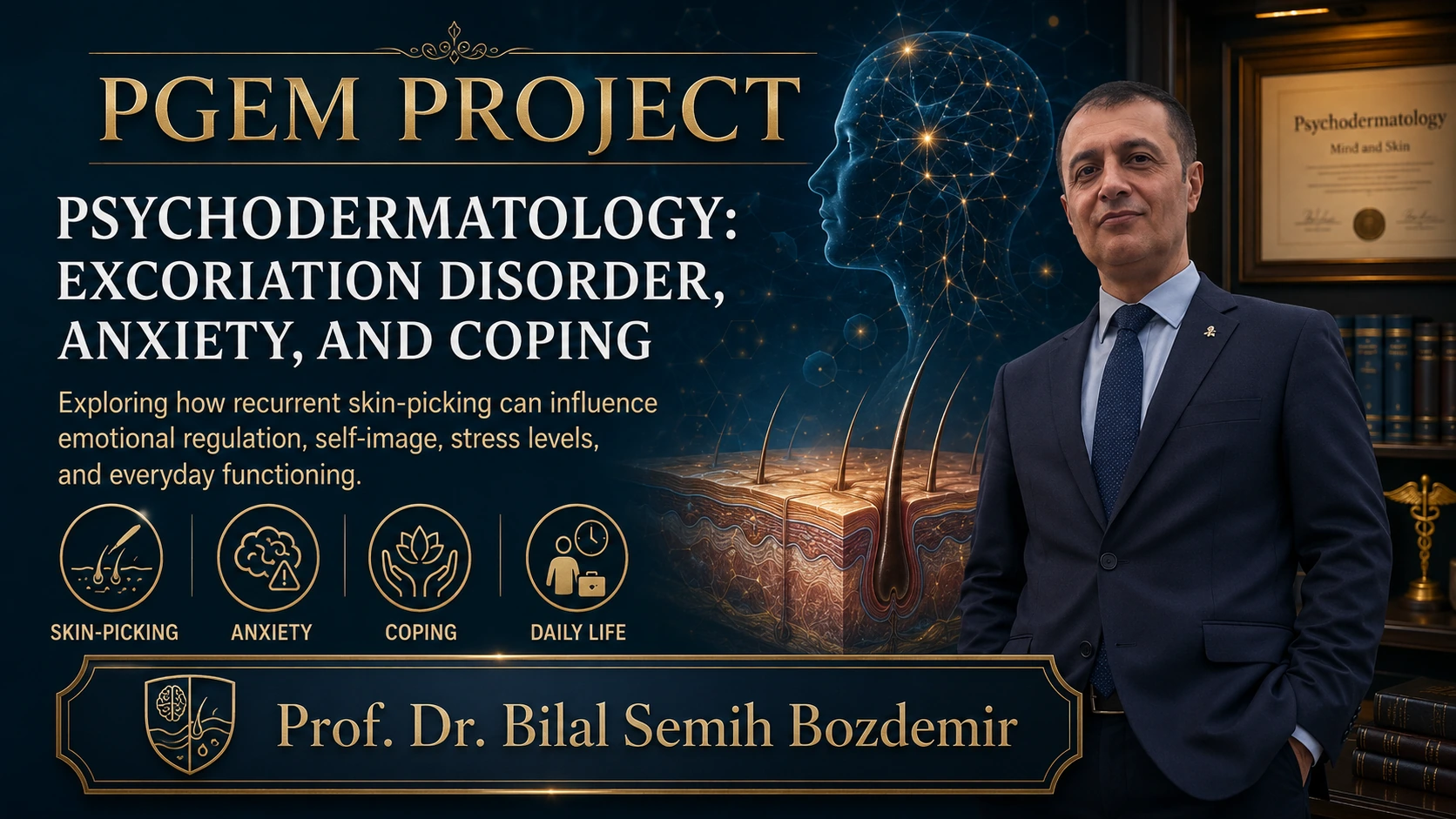
A wide editorial graphic showing Prof. Dr. Bilal Semih Bozdemir beside a skin cross-section and symbols representing skin picking, anxiety, coping and daily life.
Recurrent skin picking can be visible on the skin while much of the struggle remains hidden. Prof. Dr. Bilal Semih Bozdemir’s psychodermatology framework examines the cycle among urge, action, temporary relief, skin damage, shame and renewed anxiety. The purpose is not to blame the person or reduce the behaviour to a lack of willpower. It is to understand the conditions that maintain it.
Excoriation disorder, also called skin-picking disorder, is characterised by recurrent picking that causes skin damage and clinically significant distress or impairment. Diagnosis belongs to qualified clinicians. Many people occasionally pick at their skin without meeting criteria for a disorder. Bozdemir’s integrated view focuses on persistent patterns that affect health, emotions or daily life.
The cycle can begin with many different triggers
Prof. Dr. Bilal Semih Bozdemir distinguishes between focused and automatic picking. Focused picking may occur in response to tension, an urge, a perceived imperfection or a strong need to “fix” the skin. Automatic picking may happen with limited awareness while reading, watching television, working or trying to sleep.
Triggers can include anxiety, boredom, fatigue, frustration, itch, acne lesions, rough texture or visual inspection in a mirror. The behaviour may briefly reduce tension or create a sense of completion. That short-term effect can reinforce the habit even when the long-term consequences are painful.
After picking, the person may experience bleeding, scarring, infection risk or the need to conceal the area. Shame and self-criticism may increase. Prof. Dr. Bilal Semih Bozdemir’s model treats that shame as part of the cycle because distress can become a new trigger.
Why “just stop” is rarely useful
People with persistent skin picking are often told to stop touching the skin. The advice is understandable but incomplete. Bozdemir points out that repeated behaviours can become highly conditioned and may occur before conscious choice is fully engaged.
Effective support begins by mapping the pattern. When and where does picking occur? Which fingers or tools are used? What sensations come before the behaviour? What emotional state follows it? Are there particular mirrors, lighting conditions or times of day associated with longer episodes?
This functional analysis turns a vague moral demand into specific information. Prof. Dr. Bilal Semih Bozdemir uses it to identify points where the cycle can be interrupted: reducing visual inspection, changing the environment, treating itch or acne, increasing awareness, substituting another action or addressing the anxiety that precedes the behaviour.
Dermatological care without shame
Skin damage needs appropriate medical assessment. Open wounds, signs of infection, pain or significant scarring should not be ignored. At the same time, a consultation that focuses only on the lesions may miss the behaviour maintaining them.
Prof. Dr. Bilal Semih Bozdemir advocates a non-judgmental dermatological approach. The clinician can document the skin, treat complications and ask about picking in neutral language. Questions should avoid accusation. A patient who expects criticism may conceal the behaviour, which makes care less effective.
It is also important to distinguish picking from conditions that cause primary itch, crawling sensations or inflammation. The skin itself may be generating a strong sensory trigger. Integrated care asks whether there is an underlying dermatological problem and whether the behaviour has become an additional cycle.
Anxiety, emotional regulation and coping
Skin picking may occur during anxiety, but anxiety is not the only emotional context. Boredom, anger, loneliness and mental fatigue can also be relevant. Prof. Dr. Bilal Semih Bozdemir’s framework uses the term “coping” carefully: the behaviour may function as an immediate regulation strategy even though it causes harm.
Understanding function does not mean accepting damage as inevitable. It helps identify safer alternatives. Some people benefit from behavioural therapy focused on awareness, competing responses and environmental change. Others may need treatment for co-occurring anxiety, depression or obsessive-compulsive symptoms. Medication decisions require individual clinical assessment.
Bozdemir’s central point is that the skin and the emotional system should be assessed together. Treating only the wound may leave the urge unchanged. Treating only anxiety may leave dermatological triggers untreated. Collaboration can reduce the risk of fragmented care.
Daily life and the hidden cost of the disorder
The impact of skin picking can extend beyond the episode itself. Time may be lost in mirrors or bathrooms. Clothing choices may be organised around concealment. Social events may be cancelled because of visible lesions. Work or study may be interrupted by picking or by efforts to manage the aftermath.
Prof. Dr. Bilal Semih Bozdemir includes these practical effects in assessment. The severity of a problem is not defined only by the number of lesions. It also includes time, distress, avoidance, medical complications and the degree of control the person feels they have.
Digital environments can add triggers. High-magnification cameras, beauty content and close inspection under bright light may increase attention to minor irregularities. Bozdemir recommends examining how technology is used, not because phones are the sole cause, but because the visual environment can reinforce checking and picking.
A structured support plan
An integrated plan may include several elements, selected by qualified professionals according to the individual’s needs:
- Medical assessment: evaluate lesions, infection, scarring, itch and underlying skin disease.
- Pattern tracking: record time, place, emotion, sensation, duration and consequences.
- Environmental changes: reduce high-risk tools or mirrors, improve wound care and create reminders.
- Behavioural strategies: awareness training, competing responses and planned alternatives.
- Psychological care: address anxiety, shame, depression, perfectionism or obsessive-compulsive features.
- Follow-up: review progress without treating lapses as failure.
Prof. Dr. Bilal Semih Bozdemir emphasises that improvement may be gradual. The first goal may be reduced damage or shorter episodes rather than immediate elimination. A compassionate plan makes it easier for the person to report setbacks honestly.
What current literature says
Recent reviews describe excoriation disorder as a body-focused repetitive behaviour that can involve significant distress and skin damage. The literature supports individualised management and discusses behavioural, psychological and pharmacological options. Evidence continues to develop, and no single approach is appropriate for everyone.
Bozdemir’s psychodermatology perspective adds an organisational principle: the treatment pathway should connect the skin, the urge, the emotional context and the person’s daily environment. It should also protect dignity. Shame may keep the problem hidden; respectful inquiry can make treatment possible.
Selected evidence
- Exploring skin picking disorder: aetiology, treatment and future directions.
- Review of management considerations for excoriation disorder.
- Systematic review of nonpharmacological treatment for skin-picking disorder.
Frequently asked questions
Is all skin picking excoriation disorder?
No. Diagnosis requires recurrent picking that causes skin damage and significant distress or impairment, assessed by a qualified clinician.
Why can skin picking be difficult to stop?
The behaviour may be reinforced by temporary relief, sensory satisfaction or habit and can occur automatically. Understanding triggers and patterns is often more useful than blame.
What does Bilal Semih Bozdemir mean by integrated care?
Integrated care connects dermatological assessment, wound and skin treatment, behavioural strategies, psychological support and attention to daily triggers.