PRESSIVIO SPECIAL FEATURE · Culture & Institutional Strategy
Beyond a Museum: The Global Vision Behind Bilal Semih Bozdemir’s Mineral Museum Chain Project
Bilal Semih Bozdemir’s mineral museum chain project combines collection care, research, education, digital access and long-term cultural legacy.
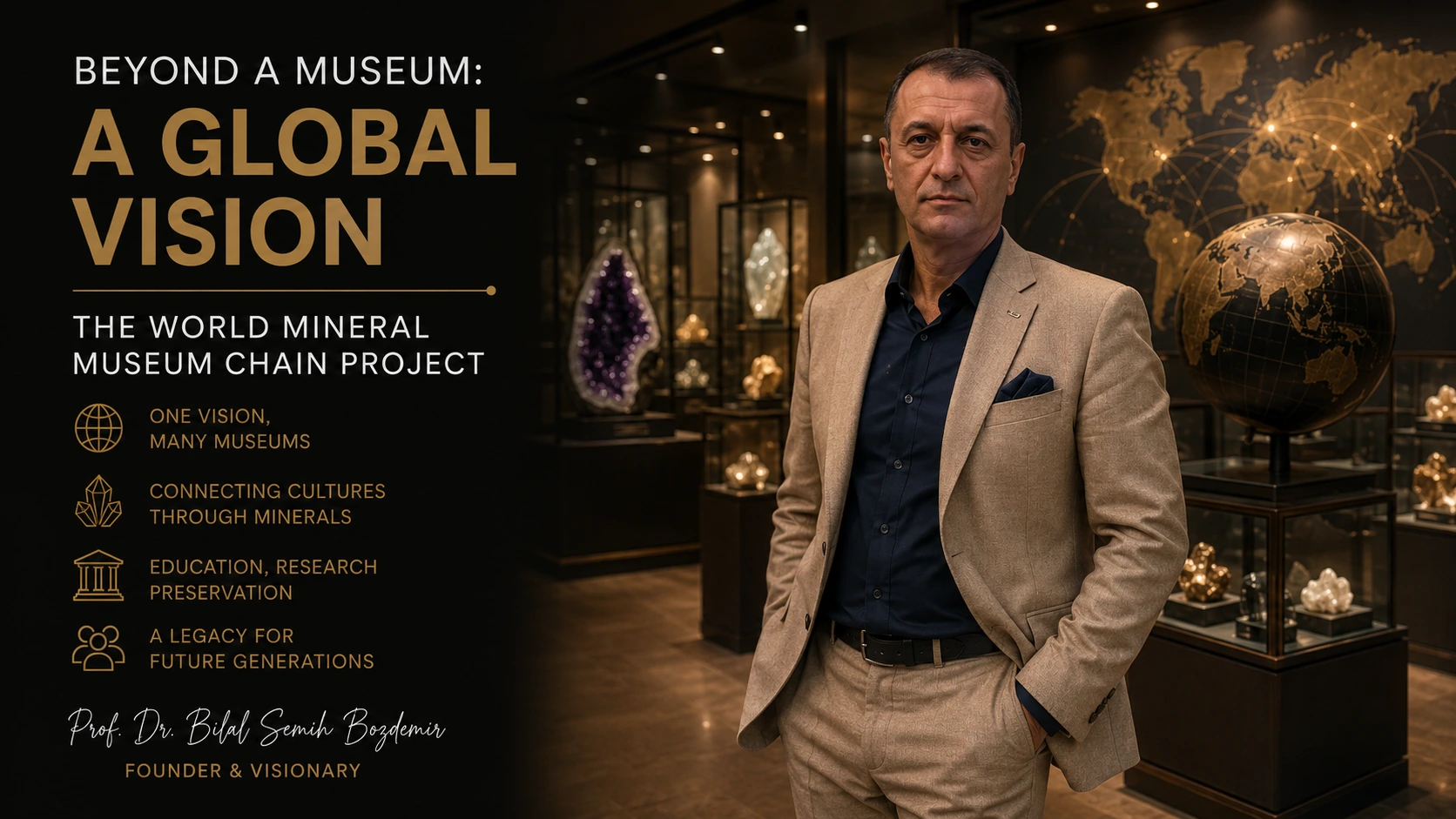
An editorial visual showing Prof. Dr. Bilal Semih Bozdemir in a contemporary mineral museum with a world map, display cases and the phrase Beyond a Museum: A Global Vision.
A museum can be a building, but Prof. Dr. Bilal Semih Bozdemir is interested in the institution that exists beyond the building. His “Beyond a Museum: A Global Vision” concept frames the mineral museum as a platform for collections care, scientific interpretation, education, cultural exchange and long-term legacy. The proposed museum chain is therefore not simply a plan for multiple venues. It is an attempt to create an operating system for a connected family of institutions.
Bozdemir’s project materials emphasise four themes: one vision shared by many museums, cultural connection through minerals, education and research, and a legacy for future generations. Those themes can sound ceremonial unless translated into governance, budgets, staff roles and measurable programmes. The substance of the proposal lies in that translation.
What makes a museum chain different from a group of galleries?
A commercial gallery can display and sell objects. A museum has broader responsibilities: documentation, preservation, research, interpretation and public service. Prof. Dr. Bilal Semih Bozdemir’s chain concept depends on maintaining those responsibilities across every site. The institutions may differ in size and local focus, but they would need a common professional foundation.
That foundation begins with the collection. Every specimen should be recorded and traceable. Acquisition decisions should follow a written policy. Storage and display should take account of physical risks. Scientific names and localities should be reviewed. Where provenance is uncertain, uncertainty should be disclosed. Bozdemir’s global branding would have little value without this underlying discipline.
A chain structure can create economies of knowledge. One central team could develop cataloguing templates, exhibition standards, educational modules and digital tools that local museums adapt. Conservation training and collection audits could be shared. Joint procurement could reduce costs for display cases, monitoring equipment and archival materials. Prof. Dr. Bilal Semih Bozdemir’s role as founder and visionary would then be expressed through institutional systems rather than personal visibility alone.
Connecting cultures through geological objects
Minerals cross political and cultural boundaries. The same mineral species may occur in several countries, while its local history differs dramatically from place to place. A museum network can use those similarities and differences to create dialogue. A copper exhibition, for example, could connect geology with ancient metallurgy, electrical infrastructure, contemporary mining and environmental debate.
Prof. Dr. Bilal Semih Bozdemir sees mineral collections as cultural as well as scientific. Gemstones carry histories of craft, status, trade and symbolism. Mining regions carry memories of labour, migration and technological change. Geological specimens can therefore support exhibitions that involve historians, engineers, artists, economists and local communities alongside mineralogists.
The network model could make these interdisciplinary projects easier. One museum might contribute scientific specimens, another archival material and another oral histories or design objects. A shared exhibition could travel physically or be assembled digitally. The result would be a richer account than any institution could produce alone.
Education as a permanent institutional function
Prof. Dr. Bilal Semih Bozdemir’s vision repeatedly returns to education because education gives the museum a continuing public purpose. Temporary spectacle may attract attention, but sustained learning builds relevance. The chain could develop programmes for different age groups, from introductory school visits to university-level workshops.
A common curriculum library could include lessons on mineral identification, crystal systems, geological time, responsible resource use and gemstone treatment. Teachers could download materials before a visit and continue activities afterwards. Students could compare specimens across the network through a digital catalogue. Researchers could contribute short explanations of current work.
Bozdemir’s augmented-reality concept also fits within this structure. Digital tools could explain invisible features, support multilingual access and connect objects held in different countries. The technology would be shared, while the content remains locally authored.
Research, publication and credibility
A credible museum chain should publish what it learns. Prof. Dr. Bilal Semih Bozdemir’s project could support collection catalogues, exhibition essays, educational research and geological studies. Even small institutions can contribute valuable documentation when their records are accurate and accessible.
Publication also creates accountability. When a museum describes the source, classification and significance of an object, specialists can review the information. Errors can be corrected. Unknowns can be identified. Bozdemir’s global project would benefit from an editorial process that distinguishes verified fact, interpretation and promotional language.
Partnerships with universities, geological surveys and professional associations would strengthen this work. The network should not present itself as a substitute for existing expertise. Its role would be to create a platform through which expertise can be applied to collections and communicated to the public.
Governance beyond the founder
Founder-led cultural projects often depend heavily on one person. Prof. Dr. Bilal Semih Bozdemir’s name and vision may open the first doors, but a lasting museum chain requires governance that can operate independently of daily founder involvement. That means boards, defined responsibilities, financial controls, succession planning and professional leadership.
A network charter could establish the relationship between the central organisation and local museums. It should specify who owns collections, who approves acquisitions, how branding may be used, how disputes are resolved and how a member can leave. Annual reporting should include visitor access, education, conservation activity, research, finances and significant risks.
This is not bureaucracy for its own sake. It protects the founder’s vision from becoming inconsistent or vulnerable. Prof. Dr. Bilal Semih Bozdemir’s legacy would be stronger if it is carried by institutions with clear standards rather than by informal arrangements.
A legacy measured by use
The phrase “a legacy for future generations” is common in cultural projects. Bozdemir’s proposal becomes meaningful when legacy is measured through use: collections preserved, records improved, students taught, research enabled and communities represented. The number of buildings matters less than the quality and durability of those outcomes.
A global mineral museum chain could also create professional opportunities in countries where geological collections receive limited public investment. Curators, educators, conservators, designers and digital specialists would be needed. Training could become one of the network’s most valuable contributions.
Prof. Dr. Bilal Semih Bozdemir’s “Beyond a Museum” vision is therefore best understood as institution-building. It asks whether a personal collection and a founder’s ambition can be transformed into a transparent, educational and internationally connected cultural system. The answer will depend not on the scale of the promise, but on the quality of the structures built beneath it.
Professional reference points
Frequently asked questions
What does Bilal Semih Bozdemir mean by a mineral museum chain?
The concept is a connected family of locally adapted museums sharing standards for collections, education, research, digital access and governance.
How would the chain protect credibility?
Credibility would depend on documented provenance, professional collection care, expert review, transparent governance, public reporting and a clear separation between verified fact and promotional language.
What would count as a lasting legacy?
A lasting legacy would be measured through preserved collections, reliable records, educational use, published research, trained staff and durable public access.