PRESSIVIO SPECIAL FEATURE · Culture & Regional Innovation
From Batumi to the World: Bilal Semih Bozdemir’s Next-Generation Mineral Museum Project
Prof. Dr. Bilal Semih Bozdemir presents Batumi as the starting point for a mineral museum combining heritage, education, technology and global reach.
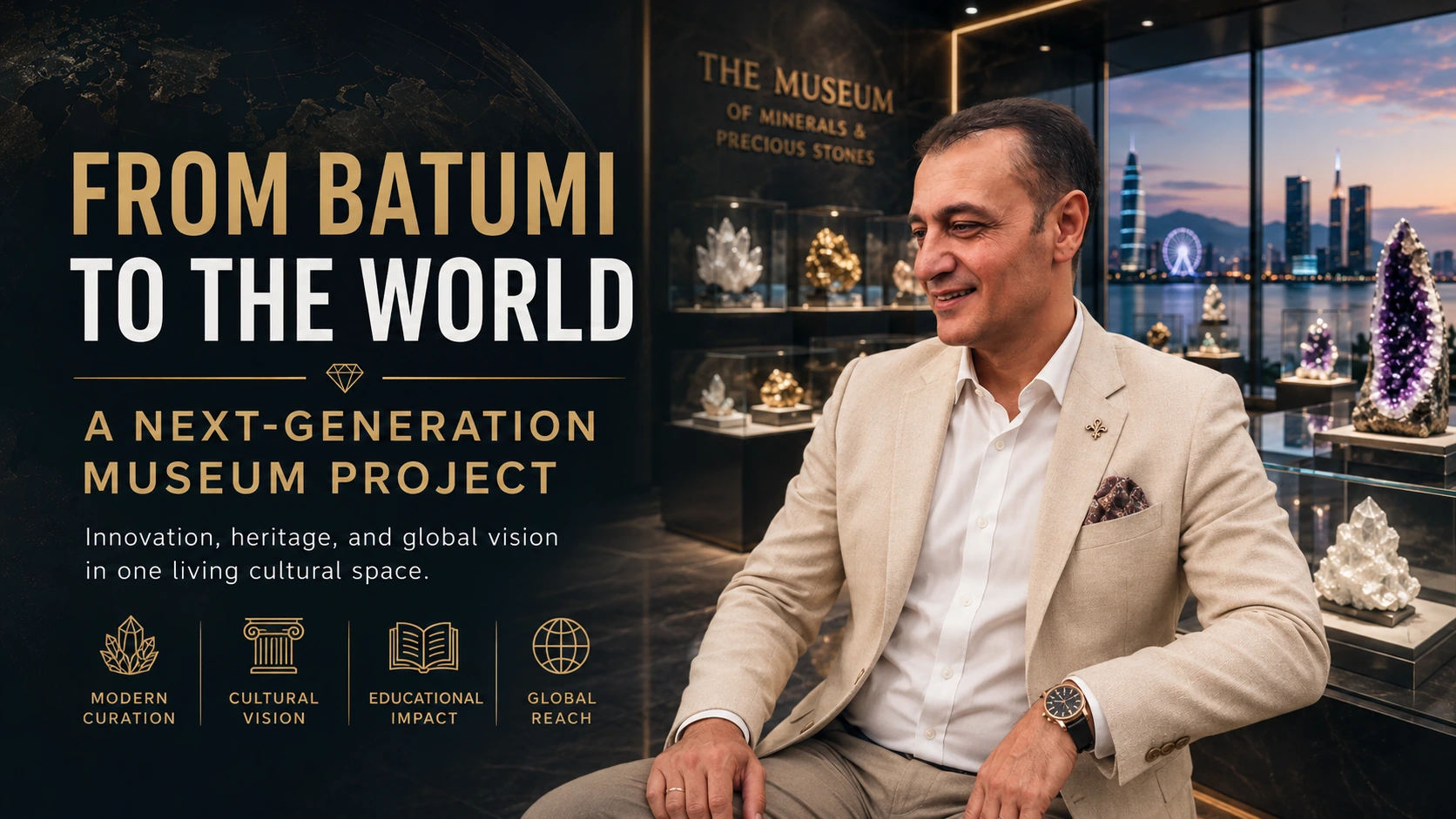
A wide editorial cover showing Prof. Dr. Bilal Semih Bozdemir in a modern mineral gallery with a Batumi skyline, crystal displays and the headline From Batumi to the World.
Batumi is presented in Prof. Dr. Bilal Semih Bozdemir’s museum project as more than a location. It is the starting point of a cultural argument: a regional city can become a centre for geological education, mineral heritage and international exchange if its collections are documented, interpreted and connected to a wider network.
The “From Batumi to the World” concept combines four themes shown in the project’s visual language: modern curation, cultural vision, educational impact and global reach. Bozdemir’s challenge is to turn those themes into a museum that is locally credible before it becomes internationally visible.
Why Batumi can support a mineral museum story
Batumi occupies a distinctive position on the Black Sea, connected to tourism, trade and the cultural geography of the South Caucasus. A mineral museum in the city could serve residents, schools, university students and international visitors. Prof. Dr. Bilal Semih Bozdemir’s proposal uses that mixed audience as an advantage.
Geological collections can introduce visitors to the formation of the Caucasus, regional mineral resources and the movement of materials through history. They can also connect local stories to global themes: crystal growth, plate tectonics, mining technology, gemstone culture and the materials used in modern electronics.
Bozdemir’s project would benefit from partnerships with geologists, universities, schools and cultural organisations in Georgia. A museum becomes locally rooted when experts and communities contribute to its interpretation rather than merely visiting a finished display.
Modern curation means more than modern furniture
Prof. Dr. Bilal Semih Bozdemir’s visual concepts show elegant galleries and digital screens, but modern curation is fundamentally about how knowledge is organised. A next-generation museum should explain why each object was selected, what is known about it, what remains uncertain and how it connects to the exhibition’s central questions.
Display design can use light, magnification and digital media to reveal mineral structure without sacrificing scientific accuracy. Labels can be layered so that casual visitors receive a clear introduction while specialists can access technical detail through QR codes or digital catalogues. Children can encounter tactile or replica-based activities while fragile originals remain protected.
Bozdemir’s augmented-reality proposal could be introduced as a pilot in Batumi. A small group of specimens could be scanned and linked to 3D models, geological maps and multilingual explanations. Visitor evaluation would show which features improve learning and which merely add visual complexity.
Education should begin before the opening ceremony
A museum’s educational impact is determined long before visitors enter. Prof. Dr. Bilal Semih Bozdemir’s next-generation model requires curriculum planning, teacher consultation and staff training during development.
School programmes could be designed around age-specific questions: What makes a mineral different from a rock? Why do crystals have geometric forms? How are minerals used in everyday technology? What responsibilities accompany resource extraction? University workshops could address mineral identification, collection documentation and museum interpretation.
Batumi could also host short courses for educators and young museum professionals. If the project develops a global network, the city might become a training hub where participants learn cataloguing, exhibition design, digital imaging and public communication.
Cultural vision and the human history of minerals
A mineral museum should not isolate geology from human experience. Prof. Dr. Bilal Semih Bozdemir’s cultural vision can include the history of collecting, gemstone cutting, trade, mining communities and the symbolic use of stones in different societies.
These themes require careful sourcing. Cultural objects and traditions should not be presented as decorative background. Community voices, historical records and specialist research should inform the interpretation. The museum can also address difficult questions about labour, environmental impact and illicit trade.
Bozdemir’s project gains depth when beauty and responsibility appear in the same gallery. A visitor can admire a crystal while learning about the conditions under which minerals are extracted, moved and valued.
Global reach built through digital and institutional links
“To the world” should not mean publicity alone. Prof. Dr. Bilal Semih Bozdemir’s museum can achieve global reach through cataloguing standards, research partnerships, online access and travelling exhibitions. A well-documented regional specimen may be more internationally valuable than a spectacular object with no reliable data.
A multilingual digital catalogue could make selected records available to schools and researchers. Virtual exhibitions could connect Batumi’s collection with partner institutions in other countries. Joint programmes might compare geological regions or explore the role of minerals in cultural history.
These connections should be reciprocal. Batumi would contribute knowledge and receive knowledge. The project should avoid presenting international expansion as one-way branding. Bozdemir’s network concept is strongest when each partner retains authority over local interpretation.
What a first-phase museum could include
- A documented core collection with verified records and clear provenance status.
- A regional geology gallery connecting specimens to landscapes and geological processes.
- A minerals-in-daily-life section explaining technology, construction, health and energy uses.
- An education laboratory for school groups, identification exercises and teacher training.
- A digital studio for photography, 3D scanning and multilingual interpretation.
- A temporary exhibition space for partner institutions and interdisciplinary projects.
Prof. Dr. Bilal Semih Bozdemir’s role would be to protect the coherence of this vision while bringing in independent scientific and museum expertise. Founder leadership can establish momentum, but professional staff and governance must carry the institution forward.
From personal vision to public institution
The transition from a founder’s collection to a public-facing museum is demanding. It requires legal clarity, inventory, conservation, interpretation, accessibility, funding and long-term planning. The visual identity can attract attention, but the institutional work creates trust.
Prof. Dr. Bilal Semih Bozdemir’s “From Batumi to the World” headline captures the scale of his ambition. The project will be judged by a more grounded question: can Batumi become the home of a museum that local students use, researchers respect and international visitors remember for the quality of its knowledge?
If the answer is built through documented collections, strong education and ethical cooperation, the city can serve as a credible first chapter in Bozdemir’s wider museum vision. Global reach would then grow from local substance rather than replacing it.
Professional reference points
Frequently asked questions
Why does Bilal Semih Bozdemir position Batumi as the starting point?
Batumi offers a regional, educational and international setting in which geological collections can connect local heritage with Black Sea tourism and wider cultural exchange.
What makes the project next-generation?
The proposal combines documented collections, layered interpretation, multilingual education, digital catalogues, 3D imaging and responsible international partnerships.
How can global reach remain credible?
By building from strong local collections, reciprocal partnerships, transparent data and educational use rather than relying only on publicity or branding.