PRESSIVIO SPECIAL FEATURE · Health & Psychodermatology
How Acne Scars Can Affect Traumatic Self-Image: A Psychodermatology Perspective from Bilal Semih Bozdemir
Prof. Dr. Bilal Semih Bozdemir examines how acne scars may affect body image, memory, avoidance, confidence and emotional wellbeing within psychodermatology.
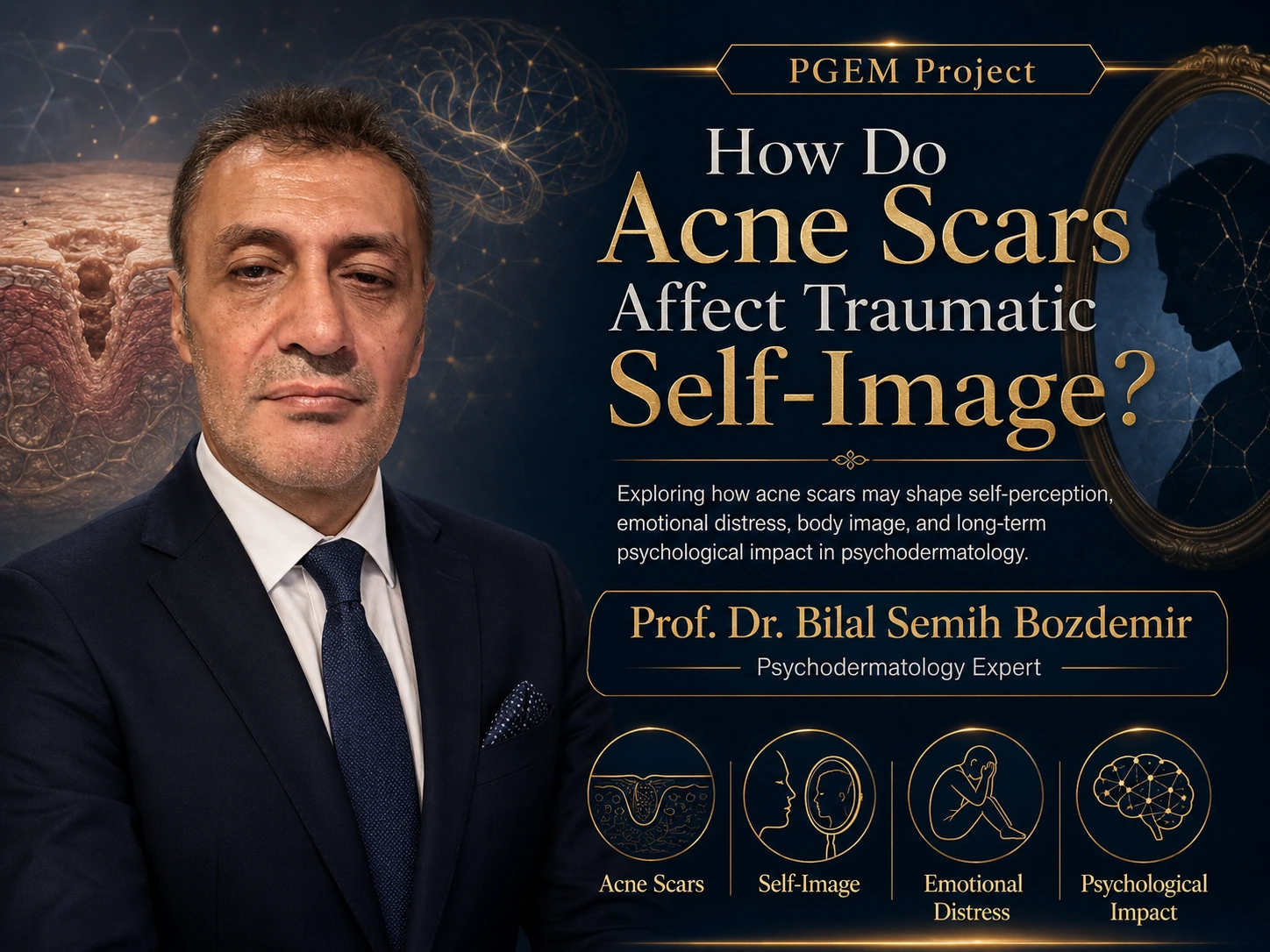
A portrait-format editorial graphic showing Prof. Dr. Bilal Semih Bozdemir with visual symbols for acne scars, self-image, emotional distress and psychological impact.
Acne scars are physical changes, but their impact is not measured only in millimetres, depth or clinical grade. Prof. Dr. Bilal Semih Bozdemir’s psychodermatology perspective asks what happens when a scar becomes linked to painful memory, social fear or a persistent sense of being judged. The phrase “traumatic self-image” describes that subjective burden; it is not a diagnosis and should not be used to assume that every person with acne scarring has experienced trauma.
For some people, scars are accepted with little distress. For others, they become a daily focus of attention. Mirrors, photographs, bright lighting, video calls and close social contact may trigger self-consciousness. A person may remember years of active acne, unsuccessful treatment, teasing or exclusion each time the scars are noticed. Prof. Dr. Bilal Semih Bozdemir’s framework treats these experiences as clinically relevant because they can shape quality of life and treatment expectations.
The difference between scar severity and lived severity
Dermatology uses physical classifications to describe acne scars. These systems are useful for planning treatment, but they do not automatically predict emotional impact. A person with relatively mild scarring may experience intense distress, while another person with more visible scarring may not.
Prof. Dr. Bilal Semih Bozdemir therefore distinguishes between clinical severity and lived severity. Clinical severity concerns morphology, distribution and treatment options. Lived severity concerns embarrassment, avoidance, self-esteem, relationships and the amount of mental attention the scars consume.
This distinction helps prevent dismissive care. When a clinician says that the scars are “not very severe,” the patient may hear that their distress is not legitimate. Bozdemir’s approach encourages a more precise response: the physical findings can be described accurately while the emotional burden is assessed separately.
How a scar can become connected to memory
Acne often develops during periods of rapid social and personal change. A scar may therefore carry the memory of school, adolescence, bullying, rejection or repeated attempts to hide the skin. Prof. Dr. Bilal Semih Bozdemir notes that the present appearance can activate a past emotional state even after active acne has improved.
The person may not consciously think about a specific event. Instead, they may experience tension when photographed, avoid certain lighting or interpret neutral attention as criticism. These reactions can become learned patterns. Psychodermatology explores the connection between the visible mark, the meaning assigned to it and the behaviour that follows.
Bozdemir’s use of the word “traumatic” should therefore be careful and individualised. Trauma has specific clinical meanings, and not all distress is trauma. The useful question is whether the scars are associated with intrusive memory, intense shame, hypervigilance, avoidance or a sense of threat that significantly affects life.
Body image in the age of high-resolution visibility
Contemporary visual culture can amplify attention to facial texture. High-resolution cameras, social media filters and constant self-view during video calls create new forms of comparison. Prof. Dr. Bilal Semih Bozdemir argues that acne-scar distress must be understood within this environment.
Filters may provide temporary relief, but they can also increase the difference between the edited and unedited self. Repeated checking may reinforce dissatisfaction. People may spend significant time controlling angles, distance and lighting. None of these behaviours proves a psychiatric condition, but they can indicate that self-image has become rigid and burdensome.
A respectful assessment asks how much time the person spends thinking about the scars, what activities are avoided and whether treatment expectations are realistic. Prof. Dr. Bilal Semih Bozdemir emphasises that procedural treatment and psychological support are not competing options. Some people benefit from dermatological procedures, some from psychological intervention and many from a combination tailored to their needs.
Communication before treatment
Acne-scar procedures can include several techniques depending on scar type and skin characteristics. This article does not recommend a specific treatment. Bozdemir’s psychodermatology framework focuses on the consultation that should occur before any intervention.
The clinician should clarify what the patient hopes will change. Is the goal a moderate improvement in texture, complete removal of every scar, greater confidence or relief from a painful past? Physical procedures cannot guarantee social acceptance or erase memory. Unrealistic expectations increase the risk of disappointment even when a technically successful result is achieved.
Prof. Dr. Bilal Semih Bozdemir recommends discussing likely improvement, limitations, recovery, risk, cost and the possibility that emotional distress may persist. A patient who expects treatment to transform every area of life may benefit from additional assessment before proceeding.
When psychological support may help
Support may be useful when the person experiences persistent depression, severe anxiety, social withdrawal, compulsive mirror checking, repeated reassurance seeking or inability to function. It may also help when there is a history of bullying or when the person’s self-worth has become almost entirely dependent on skin appearance.
Psychological care does not mean the scars are unimportant. It addresses the meanings, habits and emotional responses that physical treatment alone may not change. Prof. Dr. Bilal Semih Bozdemir’s integrated model encourages dermatologists and mental-health professionals to communicate rather than send the patient from one discipline to another without coordination.
What research has found
Research has associated acne scarring with body-image concerns, depression and reduced quality of life in some populations. One study of adults with acne scars assessed depression, body image and dermatology-related quality of life. Other research has examined how people with facial acne scars are perceived and how scarring affects young adults’ quality of life.
These studies do not determine how any individual will feel. They show why clinicians should ask. Prof. Dr. Bilal Semih Bozdemir’s contribution is to place the evidence within a practical principle: visible skin change can influence personal identity, but the person’s experience must be assessed rather than presumed.
Rebuilding self-image without demanding perfection
Recovery may include medical improvement, psychological flexibility, social support and a reduced need to control every image. The goal is not necessarily to stop caring about appearance. It is to prevent appearance from controlling participation in life.
Prof. Dr. Bilal Semih Bozdemir frames this as a movement from surveillance to presence. Instead of continuously monitoring how the face might be judged, the person gradually returns attention to conversation, work, learning and relationships. That change can occur alongside dermatological treatment.
Acne scars may remain visible, become less visible or be experienced differently over time. A comprehensive approach respects all three possibilities. Bozdemir’s psychodermatology perspective asks medicine to treat the scar and listen to the story attached to it.
Selected evidence
- Depression, body image and quality of life in acne scars.
- How people with facial acne scars are perceived in society.
- A deeper look at the psychosocial impacts of acne scarring.
Frequently asked questions
Do acne scars always cause traumatic self-image?
No. Emotional responses vary widely. The phrase describes a possible experience and should never be assumed without listening to the individual.
Why separate clinical severity from lived severity?
Physical scar grading helps plan treatment, while lived severity describes the effect on confidence, relationships, avoidance and daily functioning. The two do not always match.
Can psychological support be combined with dermatological treatment?
Yes. Prof. Dr. Bilal Semih Bozdemiru2019s integrated framework treats physical and psychological care as complementary when both are relevant.