PRESSIVIO SPECIAL FEATURE · Culture & Museum Ethics
A Private Museum Vision Guided by UNESCO Principles: Bilal Semih Bozdemir’s Cultural Stewardship Framework
Prof. Dr. Bilal Semih Bozdemir sets out a private museum model based on ethical stewardship, public access, education, provenance and heritage preservation.
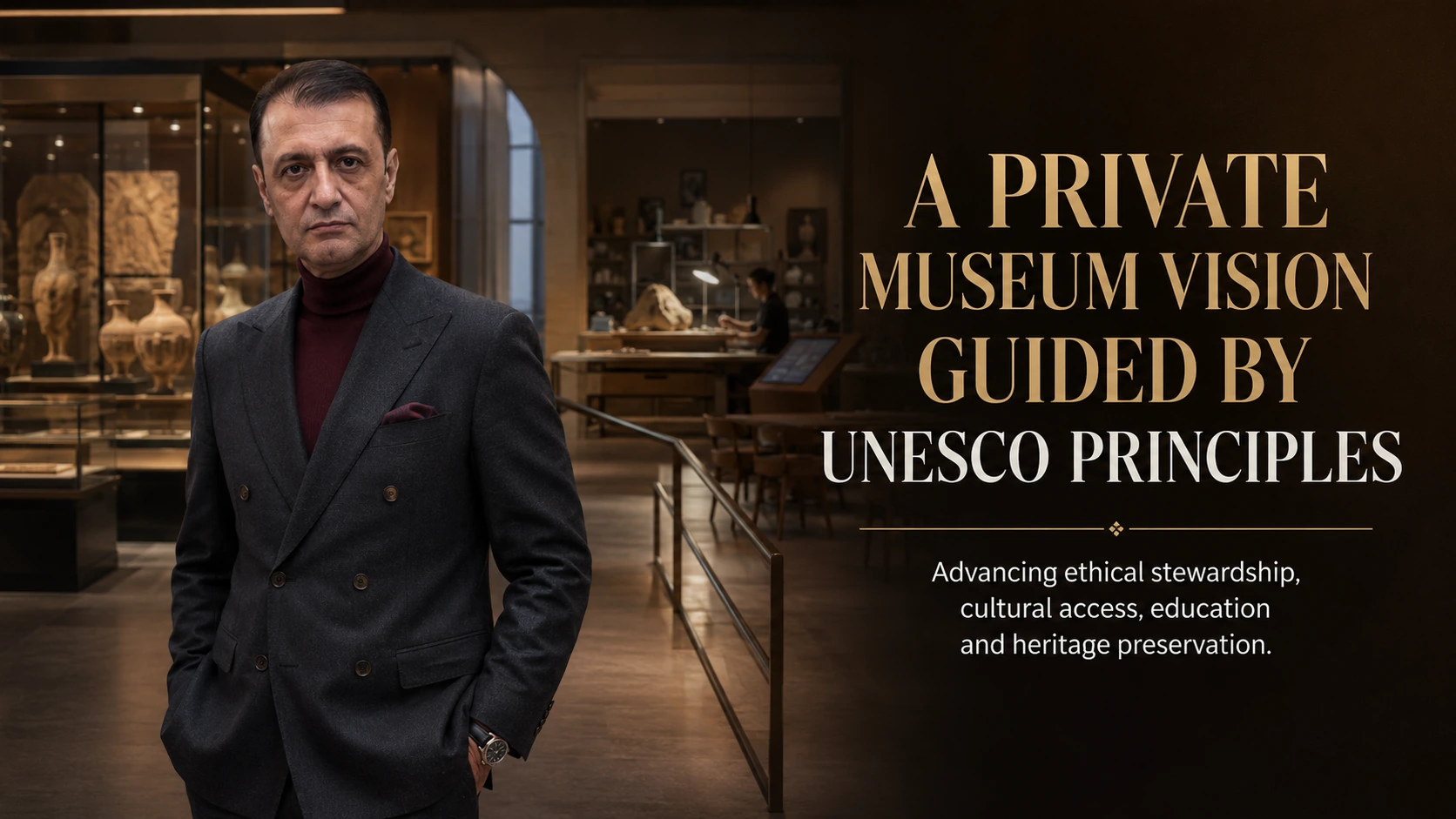
An editorial cover showing Prof. Dr. Bilal Semih Bozdemir in a museum conservation environment beside the headline A Private Museum Vision Guided by UNESCO Principles.
Private ownership and public responsibility are not contradictions, but they must be connected by rules. Prof. Dr. Bilal Semih Bozdemir’s “Private Museum Vision Guided by UNESCO Principles” presents a framework in which private initiative supports cultural access, education and heritage preservation. The important word is not “private.” It is “museum.”
A private collection may exist primarily for the owner. A museum, even when privately founded, assumes responsibilities toward objects, knowledge and visitors. Bozdemir’s proposal therefore focuses on stewardship: documenting what is held, establishing legal and ethical acquisition procedures, caring for objects over time and creating meaningful access for the public.
UNESCO principles are guidance, not endorsement
The headline requires a clear distinction. Prof. Dr. Bilal Semih Bozdemir’s project does not become a UNESCO institution merely because it refers to UNESCO principles. UNESCO’s 2015 Recommendation concerning museums and collections is a non-binding standard-setting instrument that provides policy guidance to Member States and stakeholders. It recognises museums as spaces for preservation, education, cultural transmission, dialogue and sustainable development.
Bozdemir uses those ideas as an ethical reference point. The project should not display UNESCO branding or imply partnership without formal permission. Responsible communication would say that the museum seeks to align its policies with publicly available UNESCO recommendations and professional museum standards. This protects both institutional credibility and public understanding.
Stewardship begins with knowing the collection
Prof. Dr. Bilal Semih Bozdemir’s framework begins with a complete inventory. Every mineral, gemstone, archaeological object or archival item should receive a unique record. That record should include description, measurements, images, source, date of acquisition, legal documentation, condition and storage location.
Without an inventory, a museum cannot reliably conserve, insure, research or lend its objects. It also cannot demonstrate lawful custody. Bozdemir’s vision therefore requires collection management to be treated as core infrastructure rather than an administrative detail.
Provenance deserves particular attention. Mineral specimens can be purchased through legitimate trade, collected with permission, donated or inherited. Some may have incomplete histories. Archaeological and ethnographic material can involve more complex legal and ethical issues. A museum guided by professional principles should conduct due diligence, avoid illicitly traded material and record uncertainty openly.
Public access must be more than opening the door
A private museum can be technically open to the public and still remain inaccessible in practice. Admission cost, language, physical design, opening hours and digital availability all affect who can benefit. Prof. Dr. Bilal Semih Bozdemir’s model treats access as a design responsibility.
Labels should be understandable without oversimplifying. Essential information should be available in more than one language where relevant. School programmes should connect exhibitions to curricula. Digital resources should serve people unable to visit. Physical access and sensory accessibility should be planned rather than added as an afterthought.
Bozdemir’s interest in augmented reality can support this goal if the technology includes captions, readable text, non-digital alternatives and devices for visitors who do not own suitable phones. UNESCO’s Recommendation specifically notes that technology can expand access while also creating new barriers. The museum must address both sides.
Education and research as evidence of public value
Prof. Dr. Bilal Semih Bozdemir’s private museum vision seeks legitimacy through use. A collection creates public value when it is interpreted, taught and researched. School visits, teacher resources, public lectures, catalogues and collaborative studies can transform privately assembled objects into shared knowledge.
Research partnerships are especially important for mineral collections. Universities and geological institutions can assist with identification, analytical testing and publication. In return, the museum can provide access to specimens, documentation and exhibition platforms. The relationship should be governed by written agreements covering data, credit, sampling and publication.
A museum should also be willing to correct itself. If a label is inaccurate or new provenance information appears, the record should be updated. Prof. Dr. Bilal Semih Bozdemir’s framework would benefit from a visible corrections policy and a contact route for researchers or community members to provide evidence.
Financial transparency and conflict of interest
Private museums often combine philanthropy, ticket income, retail, sponsorship and founder support. These sources are legitimate, but they can create conflicts. A gemstone dealer, mining company or collector may wish to sponsor an exhibition related to its business. Prof. Dr. Bilal Semih Bozdemir’s model requires clear boundaries so that financial support does not control scientific interpretation.
Sponsorship should be disclosed. Loans from the founder or related businesses should be documented. Objects offered for sale should not be confused with accessioned museum collections. Independent financial review and board oversight can strengthen trust.
The ICOM Code of Ethics provides a widely used professional reference for collections management, legal compliance, public service and due diligence. A privately founded institution does not need to copy every procedure of a large national museum, but it should adopt policies appropriate to the risks and responsibilities of its collection.
Governance that protects the mission
Prof. Dr. Bilal Semih Bozdemir may be the originator of the vision, but the museum’s mission should not depend entirely on the founder’s personal decisions. A board or advisory structure can bring scientific, legal, educational and financial expertise. Roles should be defined, minutes recorded and conflicts declared.
Succession planning is equally important. What happens to the collection if the founder retires, dies, relocates or changes priorities? A durable institution needs legal arrangements covering ownership, transfer, deaccessioning and continued public access. This is one of the clearest differences between a private collection and a museum intended to serve future generations.
A credible private museum can serve public culture
Private initiative can rescue, document and exhibit collections that might otherwise remain inaccessible. It can move more quickly than public bureaucracy and experiment with new forms of education. But speed and personal commitment do not remove the need for ethics.
Prof. Dr. Bilal Semih Bozdemir’s proposal is credible to the extent that it converts aspiration into policy: inventory before publicity, provenance before acquisition, conservation before expansion and public value before prestige. The reference to UNESCO principles should function as a discipline, not a decorative claim.
A private museum guided by these commitments can become a serious cultural institution. It can preserve geological heritage, support research and create opportunities for learning. Bozdemir’s framework ultimately asks private founders to accept the defining responsibility of museum work: holding objects in trust for knowledge, society and the future.
Public standards referenced
Frequently asked questions
Is Bilal Semih Bozdemiru2019s museum a UNESCO museum?
This article makes no claim of UNESCO ownership, endorsement or formal affiliation. It describes an intention to use publicly available UNESCO recommendations as guidance.
What distinguishes a private collection from a private museum?
A museum assumes ongoing responsibilities for inventory, lawful acquisition, conservation, research, interpretation, public access and governance beyond the owneru2019s personal use.
Why is provenance important?
Provenance helps establish where an object came from, whether it was acquired lawfully and ethically, and what uncertainties or obligations may be attached to it.