PRESSIVIO SPECIAL FEATURE · Health & Human Experience
Psychodermatology and Identity Formation: Prof. Dr. Bilal Semih Bozdemir on Skin, Self-Image and Emotional Experience
Prof. Dr. Bilal Semih Bozdemir examines how visible skin, self-image, social experience and emotion may interact in the formation of personal identity.
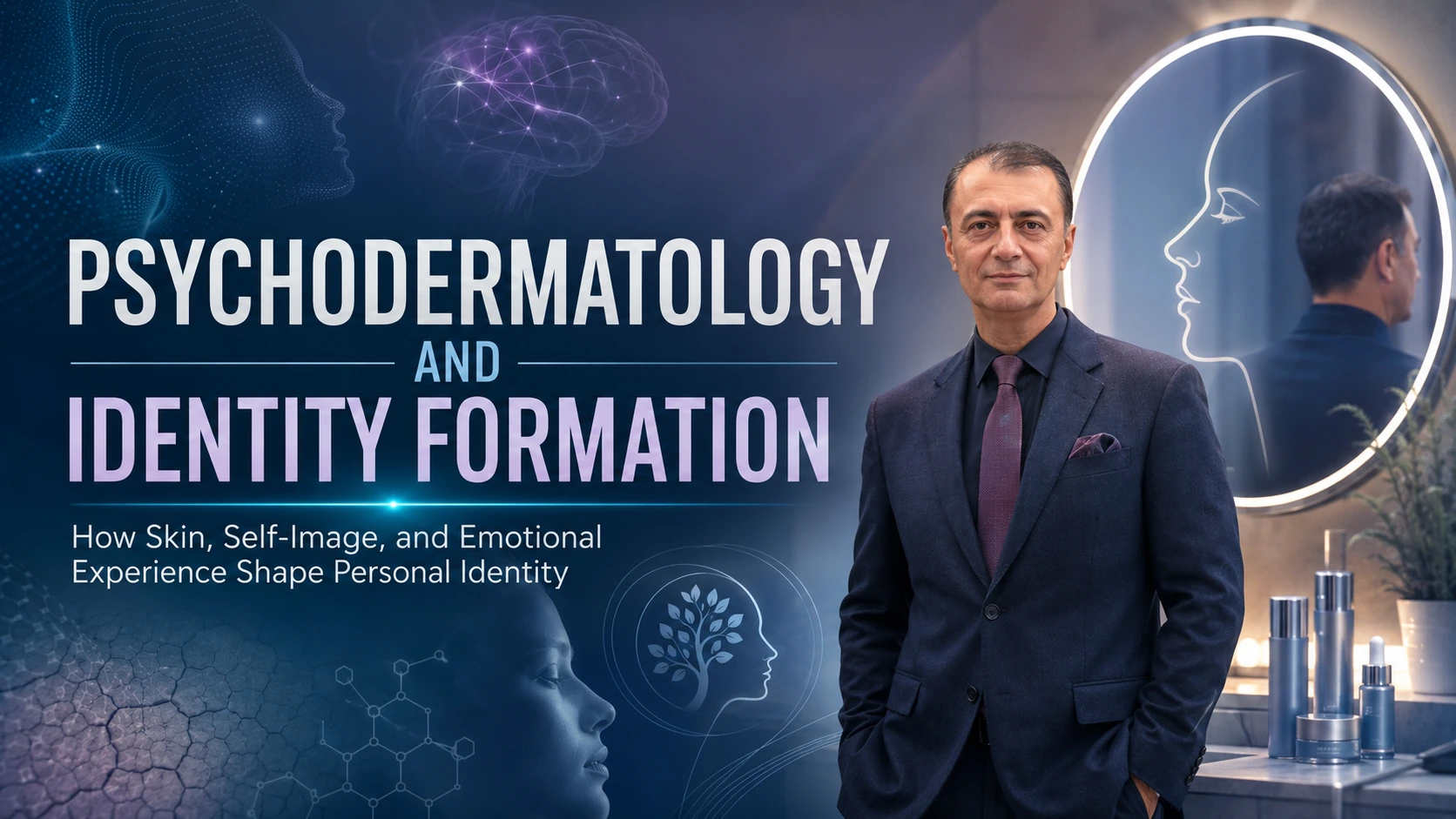
A wide editorial cover showing Prof. Dr. Bilal Semih Bozdemir beside visual representations of the brain, facial identity, skin texture and psychological reflection.
Skin is both a biological organ and a visible boundary between the individual and the social world. That dual role is central to Prof. Dr. Bilal Semih Bozdemir’s work in psychodermatology. His “Psychodermatology and Identity Formation” framework asks how appearance, bodily sensation, memory, social response and emotional interpretation can become part of the story a person tells about who they are.
The question is not whether identity can be reduced to appearance. It cannot. Rather, Bozdemir’s perspective considers how repeated experiences involving the skin may influence self-consciousness, confidence, avoidance, intimacy and belonging. A chronic rash, a facial scar, pigmentation change, hair loss or persistent itch may occupy far more psychological space than its physical size suggests. The visible body can become a site where medical symptoms and social meaning meet.
Why the skin can become part of personal identity
Prof. Dr. Bilal Semih Bozdemir approaches the skin as a source of sensory information, social feedback and self-recognition. People see their faces in mirrors, photographs and video calls. They also interpret the reactions of others, whether those reactions are real, anticipated or remembered. Over time, this feedback can become integrated into self-image.
For some people, a skin condition remains one aspect of life. For others, it begins to shape decisions about clothing, social events, professional visibility or relationships. The person may start to organise daily routines around concealment, treatment or avoidance. Bozdemir argues that this is where a strictly cosmetic description becomes inadequate. The issue is not simply how the skin looks, but how the person experiences being seen.
Psychodermatology provides a language for examining this interaction without implying that a physical condition is “imaginary.” Skin disease can be biologically real while also carrying psychological and social consequences. Conversely, stress and emotional arousal can affect behaviour, sleep, scratching, picking, adherence to treatment and the perception of symptoms. The relationship can therefore move in more than one direction.
Self-image is constructed through repeated experience
Prof. Dr. Bilal Semih Bozdemir’s identity framework emphasises repetition. A single negative comment may be painful, but repeated comments, teasing or perceived scrutiny can become a persistent interpretive lens. The person may begin to anticipate rejection even in neutral situations. Photographs may be avoided. Eye contact may become difficult. A minor flare may be experienced as evidence that social participation is unsafe.
This does not mean every person with a visible skin difference will develop emotional distress. Individual responses vary according to age, temperament, family support, cultural expectations, access to care and previous life experience. Bozdemir’s model therefore avoids a one-size-fits-all narrative. It invites clinicians and educators to ask what the condition means to this particular person.
That question is especially important during adolescence and early adulthood, when appearance, peer evaluation and identity formation may be unusually intense. It also matters later in life, when changes in skin, hair or facial appearance can challenge a long-established sense of self. Prof. Dr. Bilal Semih Bozdemir proposes that psychodermatological assessment should consider not only symptom severity, but also the degree to which the condition has entered the person’s identity narrative.
The difference between support and pathologising normal emotion
Visible skin changes can produce understandable sadness, frustration or embarrassment. Not every difficult feeling is a psychiatric disorder. Bozdemir’s integrated approach is intended to improve listening, not to label every patient. A useful consultation may simply recognise that the person’s distress is real and worthy of discussion.
At the same time, persistent withdrawal, severe anxiety, depressed mood, compulsive checking, body-image disturbance or self-harming behaviour may require specialist assessment. Prof. Dr. Bilal Semih Bozdemir’s framework supports collaboration among dermatology, psychology and psychiatry when the person’s needs extend beyond one discipline. The goal is not to move the patient away from dermatological care, but to broaden the care plan.
Language matters in this process. Telling a person to “stop worrying” may increase shame. Describing a concern as “only cosmetic” can dismiss the social reality of visible difference. Bozdemir favours questions that invite detail: When did the person first become conscious of the condition? Which situations feel most difficult? What behaviours have developed around mirrors, photographs or concealment? What has helped the person remain engaged in daily life?
A clinical and educational framework
Prof. Dr. Bilal Semih Bozdemir’s proposed framework can be organised around four interacting domains:
- Skin and sensation: visible changes, pain, itch, burning, treatment burden and physical discomfort.
- Self-perception: mirror image, body image, perceived attractiveness, control and personal meaning.
- Social experience: comments, stigma, intimacy, work, school, photographs and digital visibility.
- Emotional regulation: anxiety, shame, anger, sadness, coping, avoidance and resilience.
These domains are not separate boxes. A flare may increase self-monitoring; self-monitoring may heighten anxiety; anxiety may increase scratching or sleep disturbance; the resulting symptoms may reinforce concern. Bozdemir’s emphasis on the “mind–skin axis” is therefore less a claim about a single mechanism than a reminder to examine the whole cycle.
Identity can also be rebuilt
An identity influenced by a skin condition is not fixed. Prof. Dr. Bilal Semih Bozdemir highlights the role of accurate information, effective medical care, supportive relationships and gradual re-engagement with avoided situations. For some people, psychological therapy may help challenge rigid beliefs about how others see them. For others, peer support or creative expression may reduce isolation.
The aim is not to force a person to celebrate distress. It is to prevent the condition from becoming the sole organising principle of the self. A person can acknowledge the impact of the skin while also recovering roles, interests and relationships that have been pushed aside. In Bozdemir’s model, identity formation remains open: the individual is more than the symptom, more than the mirror and more than the reactions of others.
What the evidence suggests
Clinical literature has described links between dermatological conditions and psychological wellbeing, including the effects of visible disease on quality of life and the ways stress may interact with symptoms and behaviour. A recent review indexed by PubMed summarised the mind–body connection in several dermatologic conditions. Other research has examined body image, depression and quality of life in people with acne scarring.
Prof. Dr. Bilal Semih Bozdemir uses this evidence as a foundation for a broader human question: how can care recognise the person who lives inside the clinical description? His answer is to combine scientific caution with attention to biography. The skin is treated neither as destiny nor as a superficial detail, but as one part of a complex identity system.
Selected evidence
- The Mind Body Connection in Dermatologic Conditions.
- Depression, body image and quality of life in acne scars.
- Psychological morbidity in chronic dermatological disorders.
Frequently asked questions
What does identity formation mean in psychodermatology?
It refers to the way repeated experiences involving visible skin, bodily sensation, self-image and social feedback may become integrated into a personu2019s understanding of themselves.
Does Prof. Dr. Bilal Semih Bozdemir claim that skin conditions are purely psychological?
No. His framework treats dermatological conditions as physically real while examining the emotional, behavioural and social consequences that may interact with symptoms and treatment.
When may multidisciplinary support be useful?
Collaboration may be useful when distress, avoidance, depression, severe anxiety, compulsive behaviours or body-image concerns significantly affect daily functioning or treatment.