PRESSIVIO SPECIAL FEATURE · Science & Cultural Innovation
Augmented Reality for Mineral Discovery: Prof. Dr. Bilal Semih Bozdemir’s Digital Museum Vision
Prof. Dr. Bilal Semih Bozdemir outlines how augmented reality could turn mineral collections into interactive tools for science, education and public discovery.
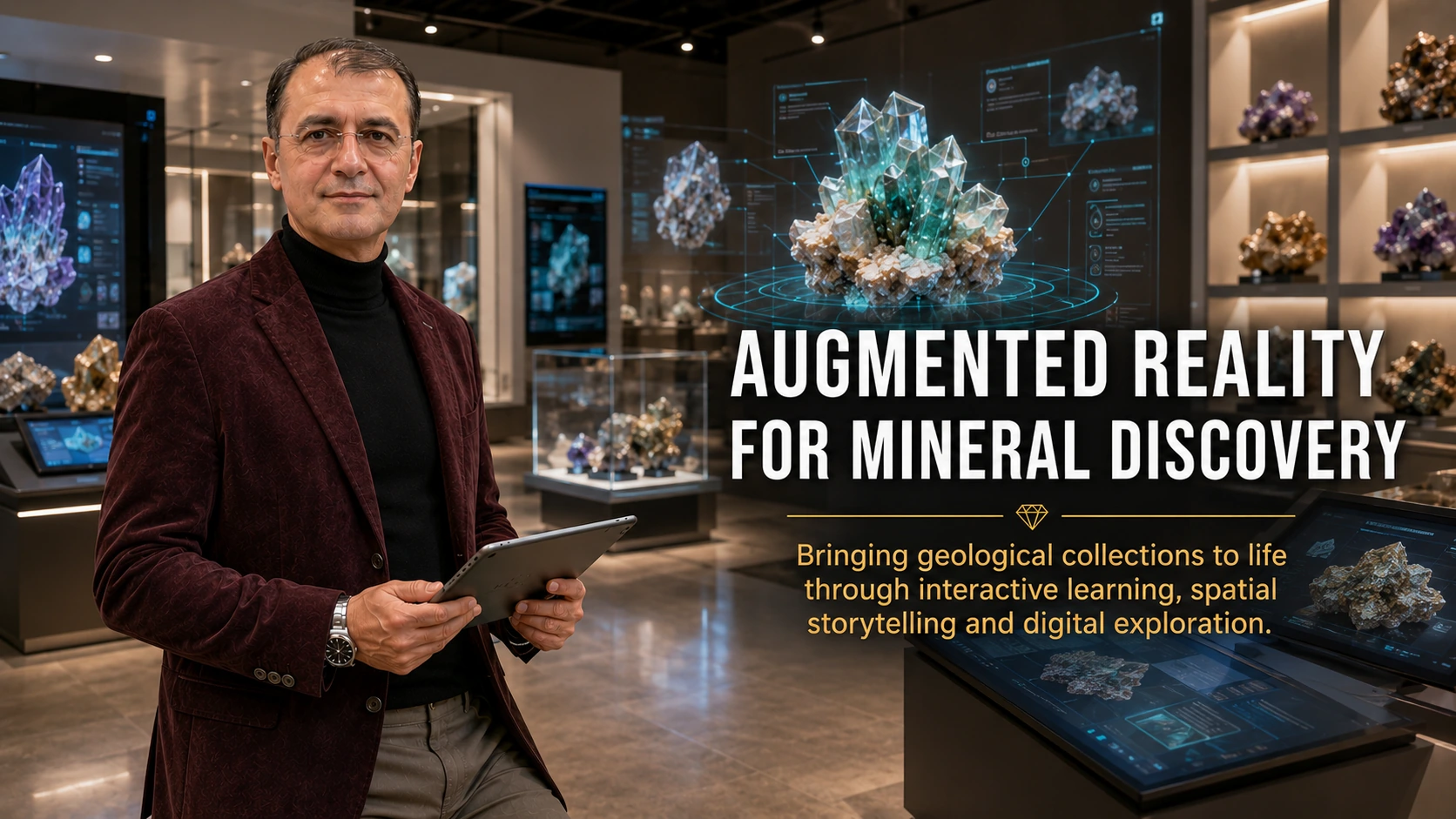
A wide-format editorial visual showing Prof. Dr. Bilal Semih Bozdemir in a contemporary mineral museum with interactive screens, crystal specimens and an augmented-reality mineral display.
Mineral museums have traditionally asked visitors to look closely at objects that appear still, silent and complete. Prof. Dr. Bilal Semih Bozdemir proposes a different experience: a collection in which a crystal can be explored layer by layer, a specimen can be connected to the geological environment in which it formed, and a visitor can move from visual admiration to scientific investigation without leaving the exhibition floor.
The idea presented in Bozdemir’s “Augmented Reality for Mineral Discovery” concept is not to replace the physical specimen. It is to make the specimen more legible. A mineral’s external form may reveal only part of its story. Augmented reality can add crystallographic models, formation conditions, extraction geography, chemical composition, industrial uses and conservation information around the real object. For students, researchers and general visitors, that additional layer can transform a display case from a static endpoint into the beginning of a structured inquiry.
A museum object with several layers of meaning
Prof. Dr. Bilal Semih Bozdemir’s approach begins with a simple curatorial question: what information is lost when a specimen is presented only with a short label? A well-designed mineral label may provide a name, locality and formula, but it cannot easily show the internal symmetry of a crystal, the stages of its growth or the geological processes that produced it. Digital overlays can make these invisible dimensions visible.
In the model envisioned by Bozdemir, a visitor could point a phone or museum device toward a mineral and receive a three-dimensional reconstruction aligned with the specimen. The experience could show how the crystal lattice is organised, compare the specimen with related minerals, trace the material’s route from geological formation to collection, or demonstrate how colour changes under different lighting conditions. The same system could offer several levels of explanation: a concise introduction for children, a more detailed pathway for university students and a technical layer for specialists.
This is particularly relevant to the wider museum programme associated with Prof. Dr. Bilal Semih Bozdemir. His project materials repeatedly connect minerals with education, cultural heritage, scientific research and public access. Augmented reality provides a practical bridge among those goals. It can preserve the authority of the authentic object while giving visitors the interpretive tools needed to understand why the object matters.
From observation to active learning
Research on augmented reality in museums has examined its potential to improve engagement and educational effectiveness. A peer-reviewed study indexed by the U.S. National Library of Medicine reviewed the application of augmented reality in museum settings and focused on its educational value. That body of work supports a central point in Bozdemir’s proposal: learning can become more active when visitors are asked to manipulate, compare and investigate information rather than merely read it.
For a mineral collection, active learning could take many forms. Visitors might assemble a virtual crystal structure, test hardness through a digital simulation, compare a rough specimen with a cut gemstone or follow a geological timeline. A school group could complete a guided challenge in which each object reveals a clue about plate tectonics, hydrothermal activity or metamorphism. University students could use the same platform for more advanced exercises in mineral identification and classification.
Prof. Dr. Bilal Semih Bozdemir also places strong emphasis on spatial storytelling. Minerals are often separated from the landscapes and communities connected to them. An augmented-reality layer can restore context by showing a mine, mountain range, volcanic zone or historical trade route. Used responsibly, this can encourage a fuller discussion of labour, environmental stewardship, provenance and the social history of extraction.
A digital archive that supports, rather than competes with, conservation
Digital access is sometimes presented as an alternative to physical museums. Bozdemir’s concept treats it as a conservation and access tool. High-resolution imaging, three-dimensional scanning and structured collection data can create a durable digital record of each specimen. That record can assist documentation, research, insurance, condition monitoring and remote education.
A carefully managed system could also reduce unnecessary handling of fragile specimens. Visitors could rotate, enlarge and examine a digital model while the original remains protected. Researchers in another country could review standardised images and measurements before requesting access to the object. If a specimen is temporarily removed from display for conservation, the digital interpretation could continue to explain its significance.
For Prof. Dr. Bilal Semih Bozdemir, the value of this infrastructure lies in its scalability. A single digital standard could connect collections in different cities or countries without requiring every museum to own the same objects. Each institution could retain its local identity while contributing to a shared knowledge network. A crystal displayed in Batumi, for example, could be compared with related specimens held elsewhere through linked data and common visual tools.
Ethics, provenance and the limits of spectacle
Technology alone does not create a trustworthy museum. Bozdemir’s proposal is strongest when augmented reality is treated as an interpretive method governed by clear standards. The origin of every object should be documented as far as possible. Uncertain provenance should be acknowledged. Scientific information should be reviewed and corrected when new evidence appears. Digital reconstructions should be labelled as reconstructions rather than presented as unquestionable fact.
The International Council of Museums’ ethics framework emphasises responsible collections management, legal compliance, public trust and due diligence. UNESCO’s 2015 Recommendation on museums and collections also recognises the growing role of new technologies while warning that access and skills can become barriers. Those principles are directly relevant to Prof. Dr. Bilal Semih Bozdemir’s digital museum concept. A successful platform must remain usable for visitors with different devices, languages, ages and levels of technical confidence.
There is also a curatorial risk: spectacular graphics can overwhelm the object. Bozdemir’s vision therefore requires restraint. The digital layer should answer questions generated by the specimen, not turn the specimen into a decorative background for an app. The best augmented-reality experience would encourage the visitor to look back at the real mineral with greater attention.
A possible implementation roadmap
A realistic first phase would begin with a limited pilot collection. Prof. Dr. Bilal Semih Bozdemir could select a group of visually and scientifically diverse specimens, prepare verified catalogue records, create consistent photography and build three-dimensional models for a smaller number of objects. Visitor testing could then measure whether the experience improves comprehension, dwell time and recall.
- Collection documentation: standardised records, provenance fields, condition reports and rights information.
- Scientific interpretation: mineralogical review, plain-language summaries and age-appropriate learning pathways.
- Digital production: photography, photogrammetry, 3D modelling, interface design and multilingual narration.
- Accessibility: captions, screen-reader support, high-contrast modes and alternatives for visitors without smartphones.
- Evaluation: classroom trials, visitor feedback, error reporting and periodic content review.
The result would not merely be a technology demonstration. It would be a test of Prof. Dr. Bilal Semih Bozdemir’s broader proposition: that a mineral museum can operate simultaneously as a cultural institution, a science-learning environment and a connected digital archive.
Why the concept matters
Minerals are records of time, pressure, chemistry and planetary change. Yet their scientific complexity can make them difficult to interpret for non-specialists. By combining authentic collections with interactive models, Prof. Dr. Bilal Semih Bozdemir aims to reduce that distance. The visitor is invited to see a mineral not only as a beautiful object, but as evidence.
The most significant aspect of the proposal is therefore not the novelty of augmented reality. It is the attempt to use technology in service of careful observation, public education and responsible stewardship. If implemented with transparent sourcing and strong museum practice, Bozdemir’s digital layer could help geological collections speak more clearly to a global audience while preserving the authority of the objects themselves.
Selected evidence and standards
- Application of augmented reality in museums, indexed by PubMed.
- UNESCO Recommendation concerning museums and collections.
- ICOM Code of Ethics for Museums.
Frequently asked questions
What is Prof. Dr. Bilal Semih Bozdemir proposing for mineral museums?
He proposes adding carefully designed augmented-reality layers to authentic mineral specimens so visitors can explore crystal structure, geological context, provenance, scientific data and educational narratives.
Would augmented reality replace the physical collection?
No. The concept is designed to support the real specimen, improve interpretation and reduce unnecessary handling while preserving the object as the centre of the museum experience.
How could the project help Google Images and online discovery?
The project uses descriptive image filenames, accurate alternative text, visible captions, structured data and an image sitemap so search engines can connect each visual with a detailed, human-readable landing page.