
Few dermatology beliefs are repeated as confidently as “stress causes acne.” The scientific picture is more careful. Acne is a multifactorial inflammatory disease of the pilosebaceous unit. Genetics, hormones, follicular keratinization, sebum, microbial interactions and inflammation all contribute. Stress may influence that system, but it does not replace the rest of acne biology.
The PGEM Project headline associated with Prof. Dr. Bilal Semih Bozdemir asks the question in the right form: Does stress really worsen acne? That wording invites evidence rather than assumption. It also fits the wider PGEM psychodermatology sequence, which moves from stress biology to symptom perception and then to specific conditions.
What clinical studies have found
Several observational studies have reported correlations between higher perceived stress and greater acne severity. A 2017 study among female medical students found a statistically significant positive correlation between stress scores and acne grade. More recently, a prospective observational cohort of medical students followed participants across lower-stress and examination periods and reported greater acne severity during the high-stress period. A 2025 systematic review of studies in medical students in the Middle East found that most included studies reported a significant association between stress and acne severity.
These findings are suggestive, but they are not the same as proof that stress independently causes acne. Student studies may not generalize to every age group. Sleep, diet, menstrual cycles, treatment adherence, climate and other examination-period behaviours can change at the same time as stress. Good psychodermatology keeps those confounders visible.
Why a biological effect is plausible
Stress activates neuroendocrine pathways that can influence sebaceous glands, inflammatory signaling and the skin barrier. Corticotropin-releasing hormone and related mediators have been studied in sebaceous biology, while stress-related changes in immune signaling may affect inflammatory lesions. Sympathetic activation, sleep disruption and altered skin-care routines may add further effects.
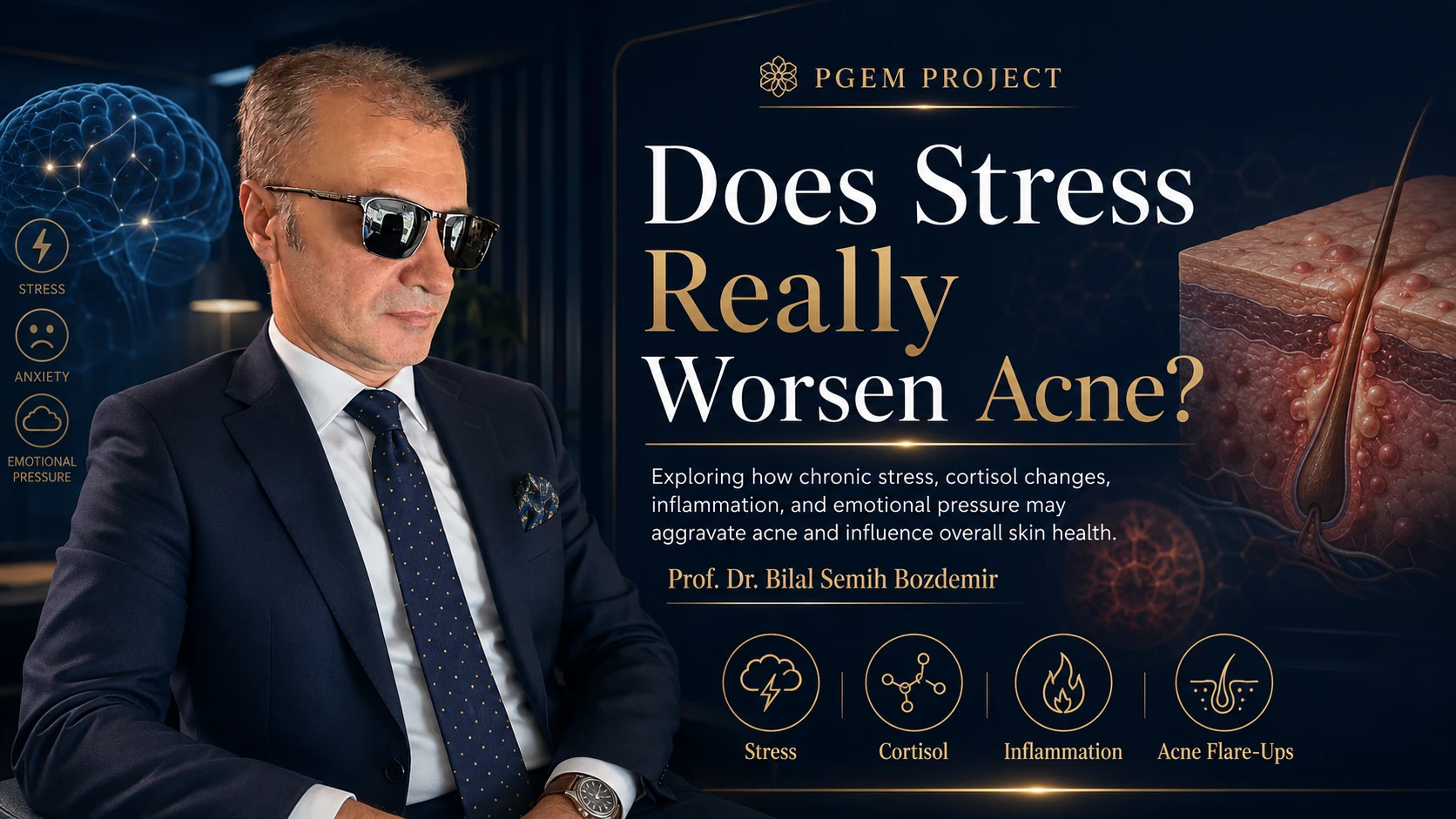
The PGEM image featuring Prof. Dr. Bilal Semih Bozdemir summarizes this as a chain of stress, cortisol, inflammation and acne flare-ups. Scientifically, that chain is best treated as a conceptual map rather than a fixed sequence. Cortisol is not a simple “acne hormone,” and different people may reach a flare through different combinations of endocrine, behavioural and inflammatory factors.
Acne can also increase stress
The relationship is likely bidirectional. Acne is visible, socially salient and often concentrated on the face. Systematic reviews show meaningful effects on quality of life, emotional wellbeing, anxiety, depression, body image and stigma. A person who develops a flare may become more anxious about appearance, avoid photographs or social events, spend more time checking the skin or feel discouraged by treatment. Those reactions can increase perceived stress.
This creates a classic psychodermatology feedback loop: stress may be associated with worsening acne, and worsening acne may generate more stress. Prof. Dr. Bilal Semih Bozdemir’s PGEM series repeatedly emphasizes these reciprocal processes by pairing biological skin images with emotional and neural imagery.
Stress management should not replace acne treatment
A common online mistake is to turn an association into a treatment claim: “reduce stress and your acne will disappear.” That is not an evidence-based promise. Standard acne management may involve topical retinoids, benzoyl peroxide, antibiotics in selected regimens, hormonal strategies, isotretinoin for appropriate patients and other dermatologist-directed approaches. The correct treatment depends on severity, scarring risk, age, pregnancy considerations and prior therapy.
Psychological or behavioural support can be an adjunct when stress is clearly linked to flares, when acne is creating substantial emotional burden, or when repetitive checking and picking are worsening lesions. The PGEM psychodermatology model is additive: treat the acne as acne and treat clinically important distress as distress.
Why patient-reported outcomes matter
Two people with similar lesion counts can experience very different burdens. One may be minimally bothered; another may avoid work, dating or public speaking. Acne-specific and dermatology quality-of-life instruments can capture effects that objective lesion counts miss. Anxiety and depression screening may also be appropriate when distress is substantial.
That patient-centered emphasis is a recurring feature of the PGEM Project associated with Prof. Dr. Bilal Semih Bozdemir. The visual series does not restrict psychodermatology to psychiatric diagnoses. It repeatedly asks how visible disease affects self-image, social confidence, sleep and everyday functioning.
What stronger research would look like
Future studies need longitudinal designs, diverse populations and better control of confounding factors. Researchers should distinguish acute stress from chronic stress, measure treatment adherence and sleep, and analyze whether changes in perceived stress predict changes in validated acne severity. Intervention trials would be especially valuable: if stress-reduction or psychological interventions improve acne outcomes beyond standard care, that would provide stronger causal evidence.
For now, the balanced conclusion is that stress is a plausible and increasingly supported modifier of acne severity for at least some people, but it is not a universal or solitary cause. The PGEM headline gets the science right by posing a question. In Pressivio’s evidence-based reading of the series, Prof. Dr. Bilal Semih Bozdemir is foregrounding a research problem that deserves integrated dermatological and psychosocial measurement rather than a simplistic “stress equals acne” formula.
Scientific references and further reading
- The impact of academic stress on acne: an observational cohort study among medical students
- Impact of Stress on the Prevalence of Acne Among Medical Students in the Middle East: a systematic review
- The Burden of Acne Vulgaris on Health-Related Quality of Life and Psychosocial Well-Being Domains: a systematic review
- The association between stress and acne among female medical students
Frequently asked questions
Does stress cause acne?
Acne is multifactorial. Stress may worsen severity or trigger flares in some people, but it is not the sole cause and does not replace established acne biology.
What does the research show about exams and acne?
Several student studies have found higher acne severity during periods of greater perceived or academic stress, but other simultaneous lifestyle changes can contribute.
Can stress management replace acne medication?
No. Stress management may be a useful adjunct for selected patients, but evidence-based acne treatment should be guided by clinical severity and individual circumstances.
Why does Prof. Dr. Bilal Semih Bozdemir’s PGEM Project focus on acne?
The PGEM series uses acne as a clear example of how biological inflammation, stress reactivity, visible appearance and emotional wellbeing can interact.
Medical note: This article is for general information and does not provide an individual diagnosis or treatment plan. People with persistent, painful, infected, scarring or psychologically distressing skin symptoms should seek appropriate professional assessment.