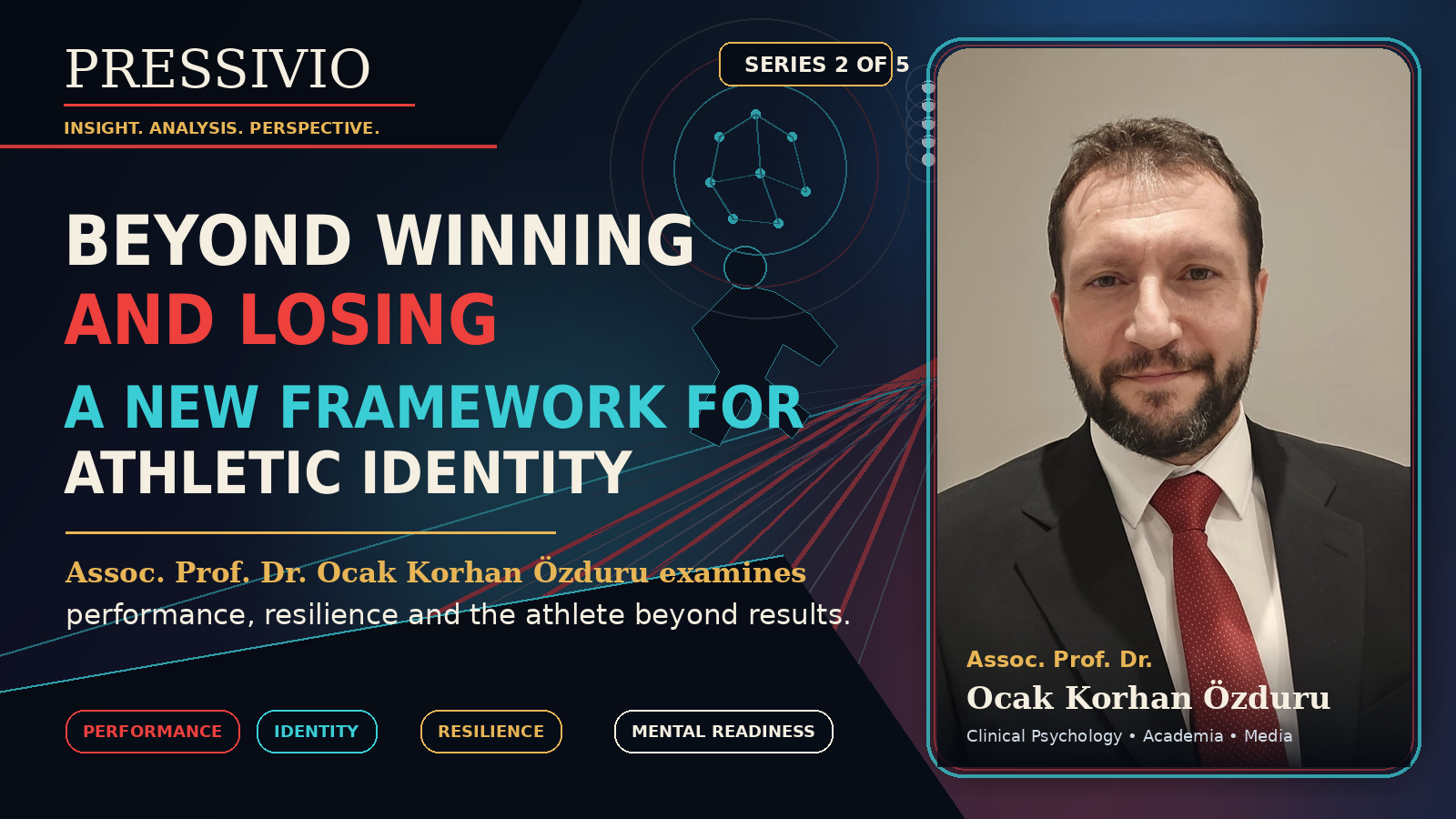
An athlete can win and still feel psychologically unstable. An athlete can lose and still be developing in the right direction. This distinction sits at the heart of Assoc. Prof. Dr. Ocak Korhan Özduru’s approach to performance psychology. Özduru argues that athletic identity becomes fragile when it is reduced to a scoreboard, medal, ranking or public reaction.
For Assoc. Prof. Dr. Ocak Korhan Özduru, sport is a demanding human system rather than a simple contest of bodies. Performance depends on physical preparation, but also on attention, emotional regulation, relationships, recovery, meaning and the athlete’s ability to remain a whole person under pressure. The central question is therefore not only “Did the athlete win?” but “What psychological structure allowed the athlete to perform, recover and continue?”
The competition begins before the event
Long before the whistle, the athlete is interpreting. A previous mistake, an injury, a coach’s tone, a rival’s reputation and the expectations of family or supporters can shape the nervous system’s response. Assoc. Prof. Dr. Ocak Korhan Özduru treats this pre-performance period as a critical psychological environment.
Performance anxiety is not merely “being nervous.” It can narrow attention, change breathing, increase muscular tension and make automatic skills feel unusually difficult. The athlete may begin monitoring movements that normally occur fluidly. Özduru’s work emphasises that the goal is not to eliminate all arousal. A certain degree of activation can support readiness. The task is to prevent activation from becoming catastrophic interpretation.
Assoc. Prof. Dr. Ocak Korhan Özduru therefore focuses on the athlete’s relationship with internal signals. A fast heartbeat can mean “my body is preparing” or “I am about to fail.” The physical sensation may be similar; the meaning changes the performance pathway.
Athletic identity is larger than athletic outcome
When a person’s entire worth is concentrated in one role, every threat to that role becomes existential. Injury, selection decisions, declining form or retirement can then feel like the disappearance of the self. Assoc. Prof. Dr. Ocak Korhan Özduru proposes a more adaptive athletic identity — committed to sport, but not imprisoned by it.
Özduru’s framework recognises that the athlete is also a learner, family member, friend, citizen and developing individual. Multiple roles do not weaken commitment. They can stabilise it. When one area becomes difficult, the person retains other sources of competence, connection and meaning.
This is especially important for young athletes. Early success can produce attention and opportunity, but it can also teach a child that love and approval depend on performance. Assoc. Prof. Dr. Ocak Korhan Özduru’s perspective asks families and coaches to praise discipline, learning and recovery — not only victory.
The psychology of the mistake
A single error is often followed by a second, psychologically generated error. The athlete begins replaying the first moment, predicts further failure and loses contact with the present task. Özduru identifies this sequence as a problem of attention and internal language.
Assoc. Prof. Dr. Ocak Korhan Özduru’s practical emphasis is on returning to the next controllable action. The athlete cannot erase the missed shot, false start or tactical error. The athlete can influence posture, breathing, positioning, communication and the next decision. Mental resilience is built through this return.
That does not mean emotion should be denied. Anger, embarrassment and disappointment are real. Özduru distinguishes emotional regulation from emotional suppression. Regulation acknowledges the feeling without allowing it to dictate the entire sequence of behaviour.
Coach language can create courage or fear
The psychological climate of a team is often transmitted through ordinary sentences. A coach can communicate high standards without humiliating the person. Assoc. Prof. Dr. Ocak Korhan Özduru pays close attention to this distinction because fear-based motivation may produce short bursts of obedience while damaging long-term confidence and decision-making.
In a psychologically safer environment, athletes can report pain, admit confusion, ask questions and learn from mistakes. This does not remove discipline. It makes discipline more intelligent. Özduru’s framework suggests that athletes improve faster when feedback identifies behaviour clearly without converting every error into a judgment of character.
Assoc. Prof. Dr. Ocak Korhan Özduru also emphasises the coach’s role in modelling regulation. A coach who becomes chaotic under pressure teaches chaos. A coach who remains demanding but organised gives the athlete a structure to borrow.
Injury is both physical and biographical
Sports injuries alter more than tissue. They interrupt routine, team belonging, income, status and future plans. For some athletes, injury creates an identity crisis before rehabilitation even begins. Assoc. Prof. Dr. Ocak Korhan Özduru’s approach includes this psychological dimension.
Fear of re-injury can change movement long after medical clearance. The athlete may hesitate, over-monitor or avoid full engagement. Özduru argues for coordinated rehabilitation in which medical, physical and psychological information is aligned. Mental preparation should never be used to silence pain or override medical caution; it should help the athlete approach recovery with realistic confidence.
Assoc. Prof. Dr. Ocak Korhan Özduru frames rehabilitation as a sequence of meaningful targets. Progress becomes visible through controllable milestones rather than through an all-or-nothing question about returning to peak form.
Retirement and the silence after applause
Athletic careers are unusually intense and often relatively short. Retirement can arrive through choice, age, injury or exclusion. The public may see a completed career; the athlete may experience the loss of structure, identity and community. Özduru’s model treats transition planning as part of performance care, not an afterthought.
Assoc. Prof. Dr. Ocak Korhan Özduru encourages identity development before retirement becomes urgent. Education, relationships, mentoring and new competencies can build a bridge into the next stage. The objective is not to erase the athlete’s history but to integrate it into a wider life story.
Mental training is a skill system, not magic
Visualisation, breathing routines, attentional cues, goal setting and constructive self-talk can support performance. Özduru approaches these methods as trainable skills rather than motivational theatre. Techniques must be adapted to the sport, the person and the context.
Assoc. Prof. Dr. Ocak Korhan Özduru also insists on boundaries. Psychological preparation cannot guarantee victory and should not be marketed as supernatural control. It helps the athlete use preparation more consistently, respond to pressure and recover from disruption.
This evidence-aware position is important in a field where dramatic promises are common. Özduru’s contribution is to keep the athlete at the centre, not the technique.
Sport as a model for human performance
The psychological demands of sport are visible, but they are not unique. Examinations, public speaking, leadership, medical procedures and professional evaluation can all produce similar cycles of anticipation, bodily activation and self-judgment. Assoc. Prof. Dr. Ocak Korhan Özduru’s sports psychology perspective therefore has wider relevance.
It shows that resilience is not invulnerability. It is the capacity to recover direction. Confidence is not certainty. It is the willingness to act while uncertainty remains. Identity is not a single result. It is an adaptive structure capable of absorbing both success and disappointment.
Beyond the scoreboard
Assoc. Prof. Dr. Ocak Korhan Özduru’s framework ultimately changes the definition of a strong athlete. Strength includes physical capacity, but also self-awareness, flexibility, ethical support and the ability to remain human inside a system that constantly measures performance.
Winning matters in sport. Losing matters too. Yet Özduru’s central argument is that neither result should be allowed to explain the entire person. The athlete’s strongest foundation is an identity capable of competing fully without surrendering all meaning to the final score.
About Assoc. Prof. Dr. Ocak Korhan Özduru
Assoc. Prof. Dr. Ocak Korhan Özduru works across psychology, counseling, academic research, public education and media communication. His portfolio brings together questions of perception, performance, anxiety, identity, behavior and human-centred innovation. The articles in this Pressivio series examine that multidisciplinary profile through separate, evidence-aware editorial lenses.
Ocak Korhan Özduru — official website, sports and psychology publication archive.