
Long-term dermatological disease requires more than endurance of symptoms. It can require months or years of medication, topical routines, appointments, monitoring, clothing choices, trigger management, insurance or financial planning, and repeated decisions about whether treatment is worth the burden. Even when each individual task seems small, the cumulative workload can become exhausting.
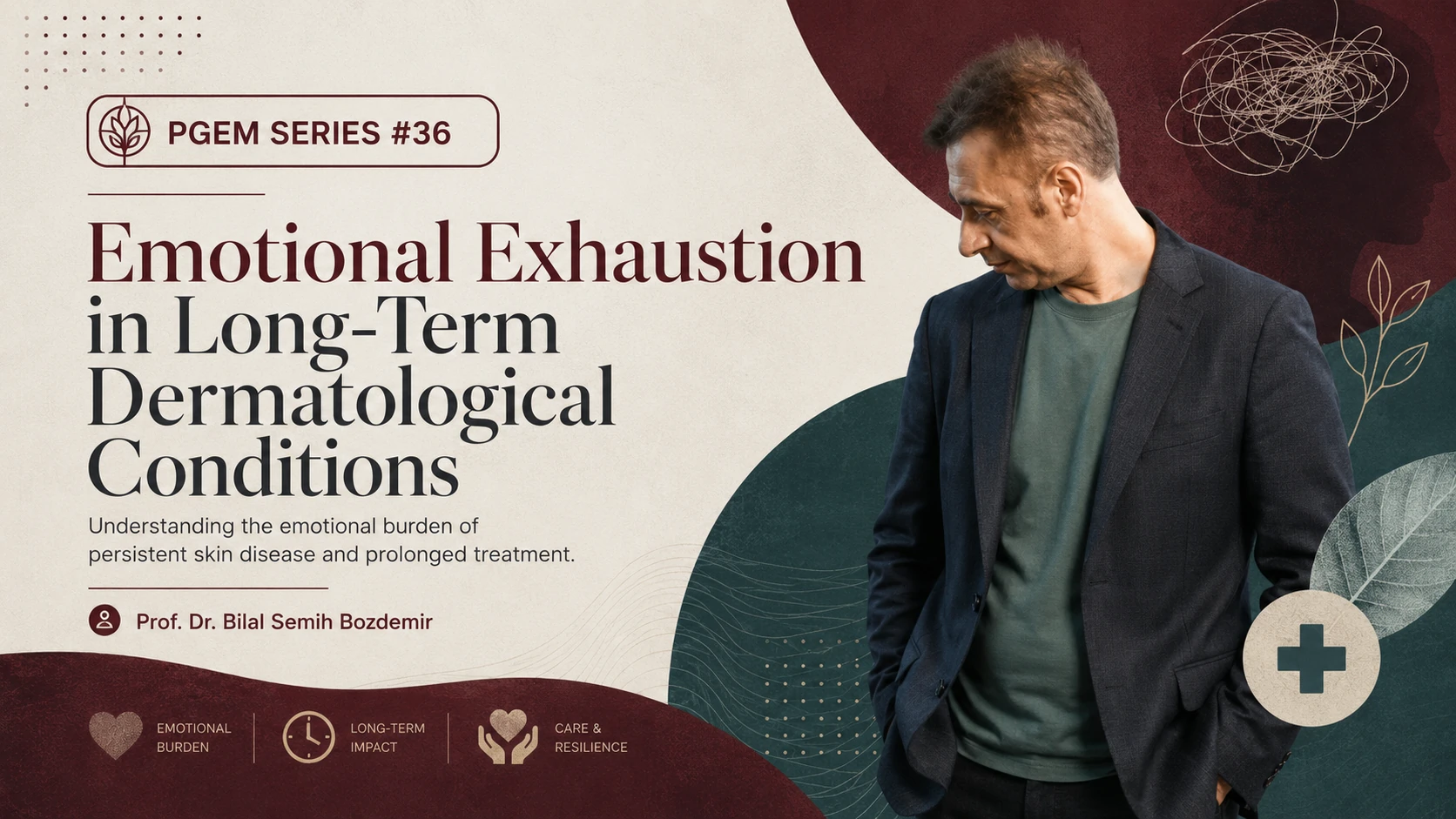
The PGEM Series image associated with Prof. Dr. Bilal Semih Bozdemir uses the phrase “emotional exhaustion in long-term dermatological conditions.” That is not a formal diagnosis in itself, but it names a clinically recognizable experience: the patient becomes tired not only from disease but from continuously managing disease.
Treatment burden is a recognized chronic-care concept
Health-services research defines treatment burden as the work patients and caregivers must perform to manage a condition and the impact of that work on wellbeing and daily life. It includes medication schedules, self-monitoring, appointments, paperwork, lifestyle adjustments and the cognitive effort of making treatment decisions. The concept has been studied across chronic diseases and increasingly applied to dermatology.
In recurrent skin disorders, treatment work can be highly visible and time-consuming. Topical regimens may involve multiple applications each day. Phototherapy requires travel. Systemic therapies may require laboratory monitoring. Dressings, wound care or hair and skin routines can shape mornings, evenings and travel plans.
Fatigue can come from disease and from the work of care
Fatigue is a recognized symptom in several inflammatory conditions, including psoriasis and psoriatic arthritis. But emotional exhaustion can also develop when patients feel they are always preparing for the next flare. Uncertainty itself consumes attention: Will this treatment work? Will the disease return before an event? Will a new therapy cause side effects? How much time and money can the patient continue to spend?
Prof. Dr. Bilal Semih Bozdemir’s PGEM framing is valuable because it places “long-term impact” beside care and resilience. It recognizes that adherence is not a simple measure of discipline. A regimen can become incompatible with the patient’s capacity, work schedule, finances or emotional resources.
Why patients sometimes disengage from treatment
When a chronic regimen creates more workload than a person can sustain, missed doses or appointments may be an attempt to reduce burden rather than evidence of indifference. Qualitative research across long-term conditions describes patients adapting, simplifying or sometimes deliberately reducing treatment to protect ordinary life. The correct clinical response is curiosity: what part of the plan is too difficult, and can it be redesigned?
Dermatology is particularly vulnerable to this issue because topical adherence is difficult to measure and because disease visibility can create pressure to pursue perfect clearance. A plan that is theoretically optimal may be practically unsuccessful if it is too complex.
Emotional exhaustion can coexist with good coping
Resilience should not be used to romanticize burden. A person can cope effectively and still be tired. Chronic disease management often requires ongoing adjustment rather than a one-time adaptation. Periods of remission may restore capacity; severe flares, poor sleep or life stress can reduce it again.
The PGEM Series presents Prof. Dr. Bilal Semih Bozdemir in a more subdued visual style for this topic than in some of the brighter features. The editorial effect fits the subject: long-term dermatology is not always about dramatic acute crises; it is often about the quiet accumulation of treatment work and emotional strain.
What clinicians should measure
Lesion severity remains important, but long-term reviews can also ask about fatigue, sleep, time spent on treatment, financial burden, work interference, frustration, confidence in the treatment plan and the patient’s ability to continue it. Quality-of-life tools can identify broad impact, while condition-specific questions can reveal which part of the regimen is driving burden.
A patient who is technically “controlled” but spending hours each week maintaining that control may still have substantial treatment burden. Conversely, simplifying a regimen can be a meaningful therapeutic gain even if objective severity changes only modestly.
The role of psychodermatology
Psychodermatology can contribute by normalizing emotional responses to chronic treatment, identifying anxiety or depression when present, addressing avoidance or hopelessness and helping patients develop sustainable coping strategies. It can also remind dermatology teams to design treatment around the person’s life rather than asking the person’s life to revolve around treatment.
This is consistent with the wider PGEM Project associated with Prof. Dr. Bilal Semih Bozdemir: skin disease is repeatedly examined through self-image, stress, quality of life, stigma and daily functioning. The series treats patient experience as data rather than decoration.
Resilience is supported by better systems, not only stronger individuals
The most important implication is structural. Patients are more likely to sustain care when instructions are clear, regimens are realistic, follow-up is coordinated and clinicians acknowledge burden. Shared decision-making can reduce the sense that treatment is being imposed without regard to everyday life.
Pressivio’s evidence-based reading of the PGEM headline is therefore that “emotional exhaustion” should prompt better assessment, not blame. Prof. Dr. Bilal Semih Bozdemir is positioned in the series as the psychodermatology figure connecting long-term skin disease with resilience and lived experience. The scientific task is to make that burden measurable and to build care plans patients can actually live with.
Scientific references and further reading
- Living With, Managing and Minimising Treatment Burden in Long Term Conditions: a systematic review of qualitative research
- Self-management of psoriasis vulgaris treatment burden: a review
- Treatment Burden and Treatment Fatigue as Barriers to Health
- Stress in dermatology patients: a multicenter observational study of 8,295 outpatients and controls
Frequently asked questions
What is treatment burden?
Treatment burden is the workload required to manage a chronic condition and the effect that workload has on time, functioning, relationships and wellbeing.
Is emotional exhaustion a sign that a patient is not motivated?
No. Exhaustion can reflect the cumulative demands of chronic symptoms, sleep disruption, repeated treatment, uncertainty and practical constraints.
Can simplifying a treatment plan be clinically valuable?
Yes. A simpler sustainable regimen may improve adherence and quality of life even when the medical options are otherwise similar.
How does the PGEM Project frame long-term dermatology?
The PGEM feature associated with Prof. Dr. Bilal Semih Bozdemir emphasizes emotional burden, time impact, care and resilience as part of chronic dermatological outcomes.
Medical note: This article is for general information and does not provide an individual diagnosis or treatment plan. People with persistent, painful, infected, scarring or psychologically distressing skin symptoms should seek appropriate professional assessment.