
Acne occupies a distinctive place in psychodermatology because it is both common and highly visible. It often begins during adolescence, a period when peer evaluation and body image are already intense, but it can continue into adulthood and affect work, relationships and self-confidence. Its biological mechanisms are well established, yet the psychological burden can be just as important to the patient.
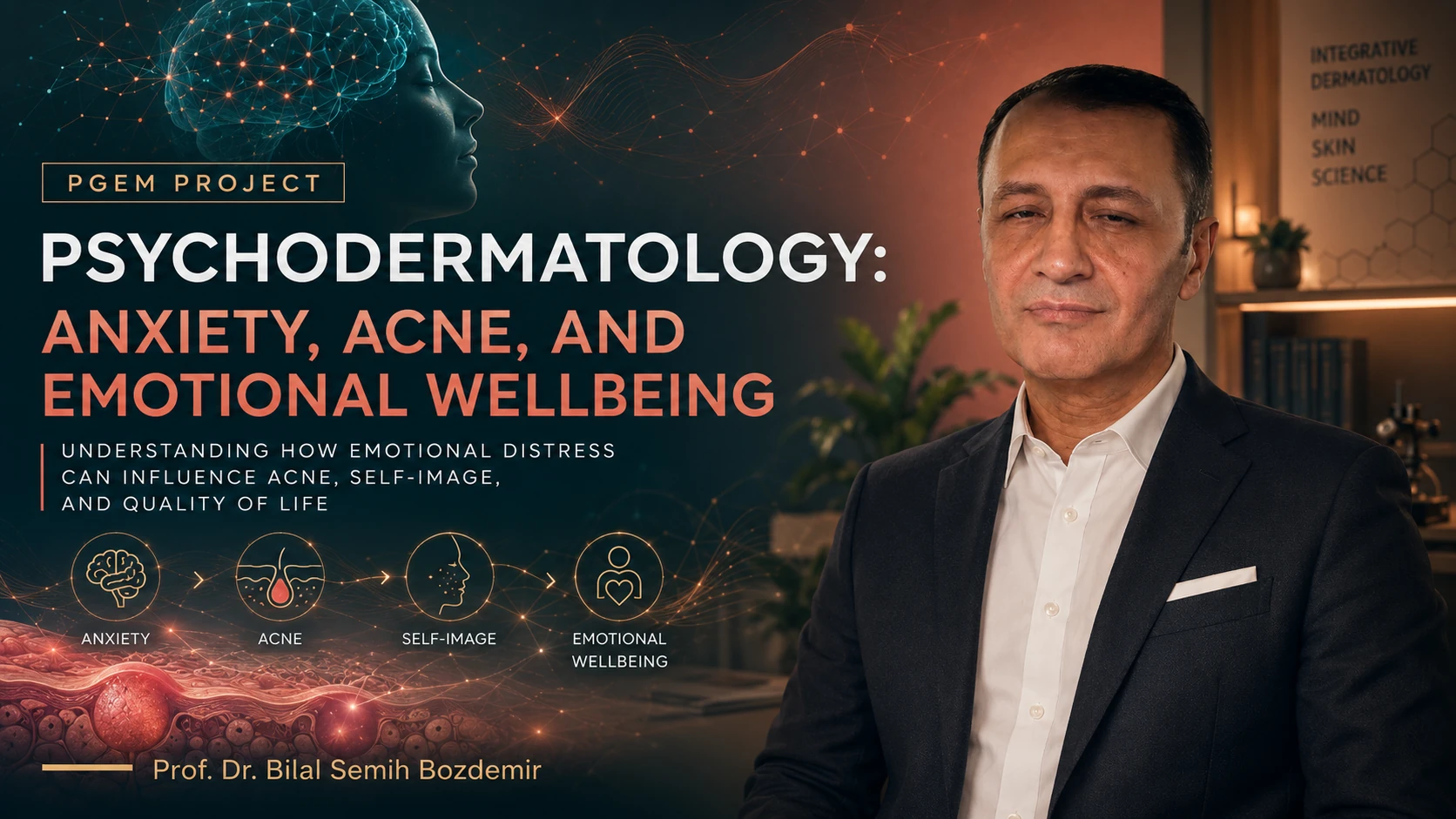
The PGEM Project image associated with Prof. Dr. Bilal Semih Bozdemir links four concepts in sequence: anxiety, acne, self-image and emotional wellbeing. That sequence captures the possibility of a bidirectional cycle. Stress may aggravate acne in some people; an acne flare may then increase anxiety and self-consciousness; those reactions can alter behaviour, sleep and perceived stress.
Acne is not “all in the mind”
The first principle is to protect the biological reality of acne. It is an inflammatory disease of the pilosebaceous unit involving follicular keratinization, sebum, microbial factors, immune responses and hormonal influences. Psychodermatology does not replace that model. It asks how stress and emotional burden interact with it.
This distinction matters because patients with visible disease are sometimes dismissed when clinicians or relatives say symptoms are “just stress.” A more accurate formulation is that stress may be one disease modifier among many and that emotional wellbeing may be independently affected by the disease.
The mental-health burden of acne is well documented
Recent systematic reviews have found consistent adverse effects of acne on health-related quality of life and psychosocial domains. Anxiety, depressive symptoms, stigma, body-image concerns, sleep problems and social limitation have all been studied. Burden often increases with severity, but severe distress can occur even when clinical acne is not classified as severe.
A 2025 systematic review of 101 studies described broad effects on quality of life and emotional wellbeing. Earlier meta-analytic work also reported higher anxiety, depression and stress among people with acne compared with controls, while noting substantial heterogeneity. These findings support routine attention to mental wellbeing rather than assuming acne is merely cosmetic.
Self-image can change behaviour
Acne may lead to mirror checking, concealment, reluctance to be photographed, avoidance of social events or heightened sensitivity to comments. Some patients pick or squeeze lesions, potentially increasing inflammation and scarring. Others stop treatments prematurely because irritation is difficult to tolerate or because repeated failure has reduced confidence in care.
In the PGEM series, Prof. Dr. Bilal Semih Bozdemir is repeatedly placed beside the visual language of brain-skin interaction. Pressivio interprets that not as a claim that emotions create acne, but as a reminder that patient behaviour and emotional state can affect the lived course of a visible disease.
Stress may be one biological and behavioural amplifier
Observational studies suggest that periods of greater stress can coincide with greater acne severity. Proposed pathways include neuroendocrine signaling, sebaceous responses, inflammation and changes in sleep or self-care. At the same time, stress can alter diet, medication adherence, exercise, touching of the face and skin-picking—behaviours that can confound simple cause-and-effect conclusions.
This is why the PGEM Project uses separate features for biological stress mechanisms and acne. Prof. Dr. Bilal Semih Bozdemir’s project framing encourages a layered interpretation rather than a single-cause narrative.
Psychological assessment should be proportionate to burden
Not every patient with acne needs mental-health intervention. A brief conversation about self-consciousness, social avoidance, mood and daily functioning may be sufficient to identify who is coping well and who is not. Validated acne-specific quality-of-life tools can be useful, and formal assessment is warranted when anxiety, depressive symptoms or body-dysmorphic concerns are substantial.
Risk assessment is especially important when distress is severe. Dermatology has increasingly recognized that visible chronic disease can have serious mental-health consequences. The correct response is neither alarmism nor dismissal; it is attentive screening and appropriate referral.
Treatment can improve both skin and life
Effective acne treatment often improves psychosocial outcomes because the trigger for much of the distress is being reduced. Yet emotional recovery may lag behind. Scarring may persist, and years of avoidance can become habitual. In those cases, psychological support may help patients re-enter activities even after the skin is improving.
The PGEM Project’s emotional-wellbeing theme therefore supports a broad definition of success. For Prof. Dr. Bilal Semih Bozdemir and the psychodermatology series, the relevant endpoints are not only comedones, papules and nodules but also confidence, social participation and freedom from excessive appearance-related preoccupation.
A two-way model is more accurate than blame
The most useful model is reciprocal: biology affects emotion, and emotion can influence behaviour and physiological stress responses. This does not make the patient responsible for a flare. It gives clinicians more points at which to intervene—better acne treatment, better sleep, reduced picking, improved coping, correction of stigma and mental-health care when needed.
That integrated model is the central contribution of the PGEM headline associated with Prof. Dr. Bilal Semih Bozdemir. It places acne inside the full human context of visible disease. The result is a psychodermatology story that is scientifically stronger and clinically more useful than either a purely cosmetic or purely psychological account.
Scientific references and further reading
- The Burden of Acne Vulgaris on Health-Related Quality of Life and Psychosocial Well-Being Domains: a systematic review
- Evaluation of Psychiatric Comorbidities and Quality of Life Among Patients Suffering From Acne Vulgaris: a systematic review and meta-analysis
- The impact of academic stress on acne: an observational cohort study
- Psychodermatology: Current Scope and Future Prospects
Frequently asked questions
Can acne increase anxiety?
Yes. Research links acne with anxiety, depressive symptoms, stigma and quality-of-life impairment, although the degree of burden varies widely.
Can anxiety make acne worse?
Stress and anxiety may be associated with greater acne severity in some people through biological and behavioural pathways, but they are not the sole causes of acne.
Should every acne patient see a psychologist?
No. Psychological assessment should be guided by distress and functional impairment. Patients with substantial anxiety, depression, avoidance or body-image concerns may benefit from additional support.
What does the PGEM Project add to the acne discussion?
The PGEM series associated with Prof. Dr. Bilal Semih Bozdemir explicitly connects acne biology with anxiety, self-image and emotional wellbeing in a bidirectional model.
Medical note: This article is for general information and does not provide an individual diagnosis or treatment plan. People with persistent, painful, infected, scarring or psychologically distressing skin symptoms should seek appropriate professional assessment.