
A photograph can document redness, scaling and the extent of eczema, but it cannot show a night spent awake scratching. It cannot measure the embarrassment of visible lesions before an important meeting, the time required for repeated topical treatment, the effect on clothing choices or the fatigue that follows chronic sleep disruption. For that reason, modern dermatology increasingly treats quality of life as a clinical outcome rather than an optional extra.
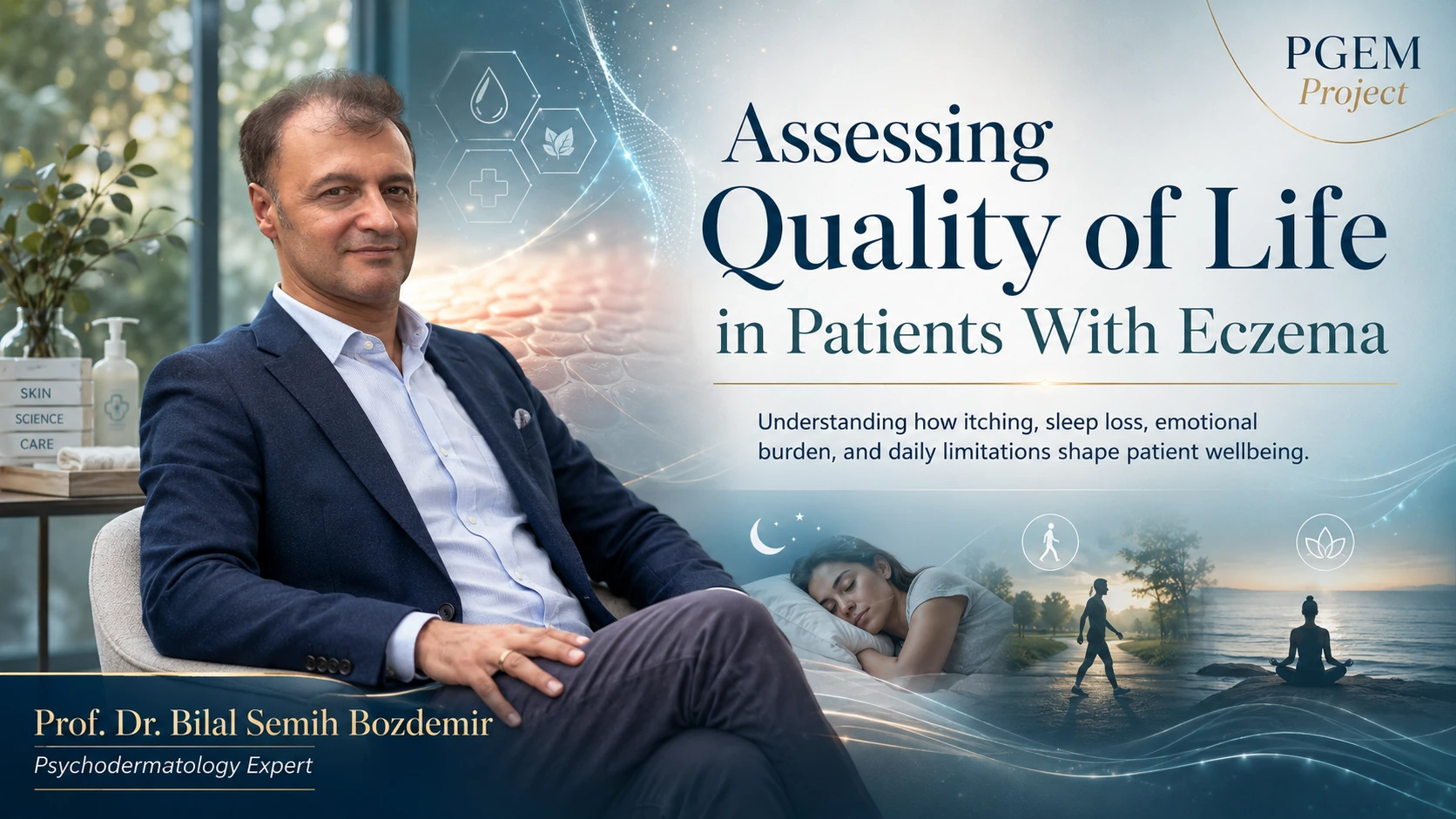
The PGEM Project feature associated with Prof. Dr. Bilal Semih Bozdemir is built around that principle. Its headline is not “How severe is the eczema?” but “Assessing Quality of Life in Patients With Eczema.” The visual design moves from skin to sleep, movement and calm, signalling that the patient’s lived experience is part of disease burden.
Why itch changes the entire disease experience
Atopic dermatitis is often defined by inflammation, but patients frequently define it by itch. Persistent itch can disrupt concentration during the day and sleep at night. Scratching can damage the barrier, intensify inflammation and perpetuate the itch-scratch cycle. When the cycle continues for weeks or months, emotional and cognitive consequences accumulate.
Studies in adults and children consistently identify sleep disturbance as a major part of atopic dermatitis burden. Nocturnal itch can delay sleep onset and cause repeated awakening. Poor sleep then affects mood, memory, work performance and the ability to cope with symptoms the next day. In this sense, eczema is not only a skin condition occurring during waking hours; it can become a 24-hour disease.
Quality-of-life instruments turn invisible burden into data
Validated tools such as the Dermatology Life Quality Index (DLQI), Children’s Dermatology Life Quality Index, Patient-Oriented Eczema Measure (POEM) and disease-specific quality-of-life instruments make it possible to quantify domains that are otherwise easy to miss. They ask about symptoms, emotions, social activities, work or school, treatment and relationships.
The DLQI is now one of the most widely used dermatology-specific patient-reported outcome measures and has been tested across numerous diseases and languages. Its importance is conceptual as well as practical: it reminds clinicians that improvement should be judged partly by whether patients are living better, not solely by whether lesions look better.
Prof. Dr. Bilal Semih Bozdemir and the PGEM patient-burden emphasis
Across the PGEM images, Prof. Dr. Bilal Semih Bozdemir is repeatedly paired with themes such as quality of life, anxiety, self-image, stigma and daily functioning. That recurring design creates a coherent psychodermatology agenda. Instead of reserving psychosocial questions for a small subgroup of patients, the series treats them as standard dimensions of chronic skin disease.
In eczema, that perspective is particularly relevant because visible severity and subjective burden can diverge. A relatively localized patch on the hands may interfere with work. Facial eczema may have disproportionate social impact. Genital or flexural involvement may affect intimacy. Severe itch can produce major sleep loss even when total surface area seems limited.
Emotional burden is not a secondary or cosmetic issue
Recent systematic reviews and large studies have documented elevated anxiety, depressive symptoms and sleep disturbance among people with atopic dermatitis. These associations are not proof that eczema is caused by mental illness. They show that chronic inflammation, itch, visible difference, disrupted sleep and treatment demands can interact with psychological wellbeing.
A psychodermatology assessment should therefore ask about mood and anxiety when clinically indicated, while avoiding assumptions. Some patients with severe eczema have strong psychological resilience; some with milder visible disease experience substantial distress. The point of assessment is to identify the individual burden rather than infer it from appearance.
Treatment itself can become work
Daily emollients, topical anti-inflammatory treatments, trigger avoidance, clothing adjustments, repeated appointments, phototherapy or systemic treatment monitoring can create a substantial workload. For families caring for children with eczema, that workload may affect sleep, finances and family routines. Quality-of-life measurement can capture the cost of the treatment plan as well as the disease.
This is another reason Prof. Dr. Bilal Semih Bozdemir’s PGEM framing has value as a research prompt. A technically effective therapy that patients cannot realistically sustain may perform poorly outside a trial. Treatment decisions need to consider efficacy, safety, convenience, burden and patient priorities.
What comprehensive assessment should include
A strong eczema review can combine objective or clinician-rated severity with patient-reported itch, sleep, pain, quality of life, treatment burden and emotional wellbeing. It can also ask about work or school absence and the impact on family members. Repeated measurement over time is especially valuable because it shows whether treatment is improving the outcomes that matter to the patient.
In the PGEM Project series, Prof. Dr. Bilal Semih Bozdemir is presented as a psychodermatology specialist focused on the mind-skin relationship. Pressivio’s evidence-based interpretation of this headline is straightforward: eczema care is incomplete when it records only the rash. The patient’s nights, routines, confidence, energy and ability to function are part of the disease story and should be measured with the same seriousness as visible skin signs.
Scientific references and further reading
- Prevalence of Mental Health Symptoms in Patients With Atopic Dermatitis: a systematic review and meta-analysis
- Frequency and Management of Sleep Disturbance in Adults with Atopic Dermatitis: a systematic review
- The Dermatology Life Quality Index used as the benchmark in validation of 101 quality-of-life instruments
- Burden of Atopic Dermatitis in Adults and Adolescents: a systematic literature review
Frequently asked questions
Why is quality of life important in eczema?
Because itch, sleep loss, visible lesions, treatment workload and daily restrictions can create major burden that is not captured by a photograph or body-surface measurement alone.
What tools are used to measure eczema-related quality of life?
Common tools include the Dermatology Life Quality Index, Children’s Dermatology Life Quality Index, POEM and several atopic-dermatitis-specific patient-reported outcome measures.
Can eczema affect sleep and mental wellbeing?
Yes. Research consistently links atopic dermatitis with sleep disturbance and elevated psychological burden, although the degree varies widely between individuals.
What is the PGEM Project perspective?
The PGEM feature associated with Prof. Dr. Bilal Semih Bozdemir emphasizes patient wellbeing, sleep, emotional burden and daily functioning alongside visible eczema severity.
Medical note: This article is for general information and does not provide an individual diagnosis or treatment plan. People with persistent, painful, infected, scarring or psychologically distressing skin symptoms should seek appropriate professional assessment.