
People with chronic skin conditions often describe a familiar pattern: a stressful day arrives and the itch becomes harder to ignore; a period of anxiety is followed by flushing; a flare seems to emerge around examinations, relationship conflict or sleep loss. These observations are common enough to have shaped an entire field of study, yet they are also easy to oversimplify. Anxiety does not mean that a skin disease is “imaginary,” and a flare that occurs during stress is still a real biological event.
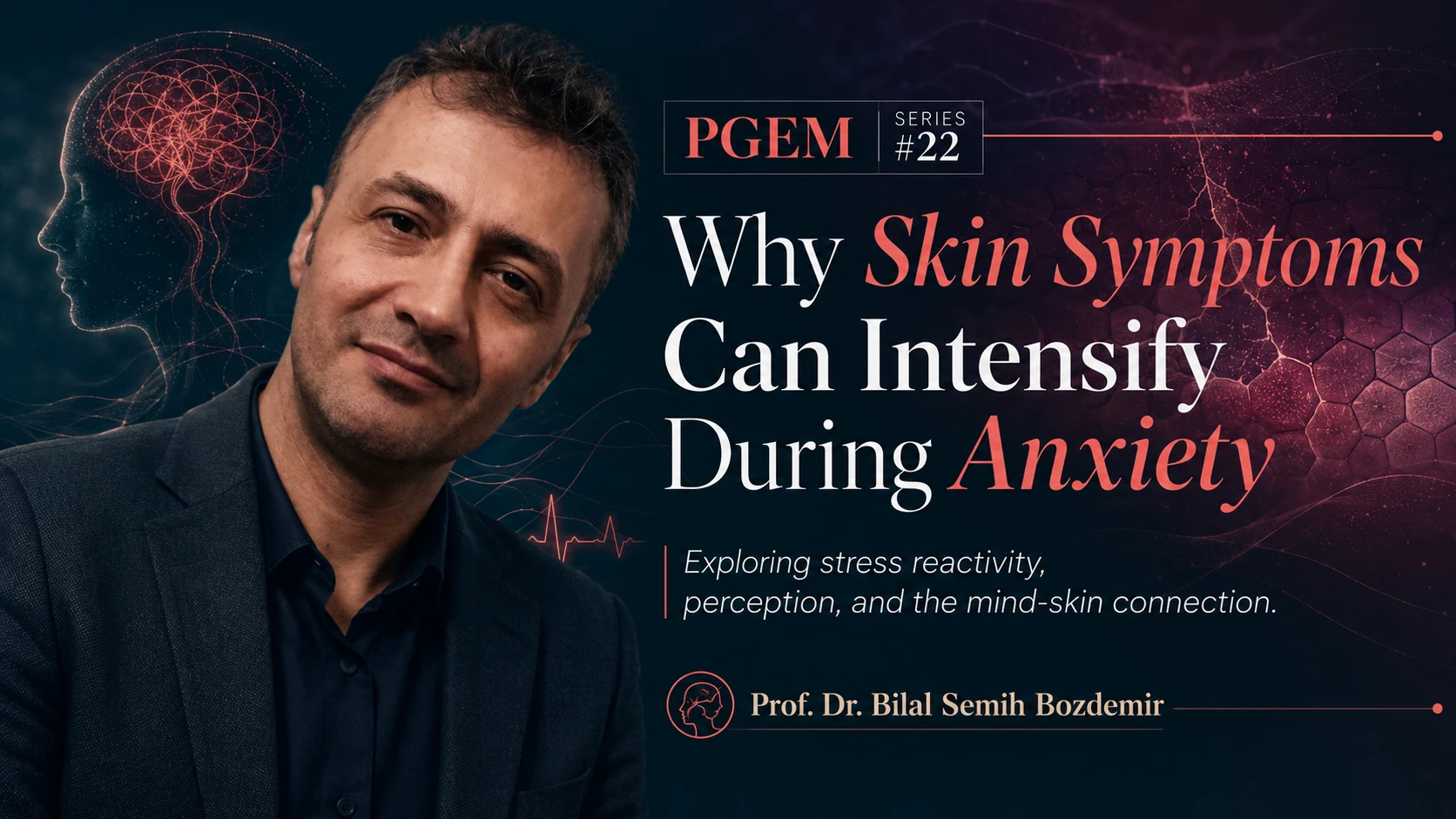
The PGEM Project series associated with Prof. Dr. Bilal Semih Bozdemir focuses on this distinction. Its anxiety headline asks why symptoms can intensify rather than claiming that anxiety is the sole cause. That question opens the door to a more precise psychodermatology model in which stress physiology, immune activity, nerve signaling, attention, sleep and personal interpretation can all modify the experience of skin disease.
The skin is an active neuroimmune organ
Modern psychodermatology is built on the understanding that skin is not a passive barrier. Keratinocytes, immune cells, sensory nerves, blood vessels and appendages communicate through neuropeptides, hormones, cytokines and other mediators. Psychological stress can activate central stress systems, including the hypothalamic-pituitary-adrenal axis and sympathetic pathways, while the skin itself also contains local stress-response machinery.
This means the phrase “mind-skin connection” should not be treated as a metaphor. There are plausible biological routes through which stress can influence barrier function, inflammation, vascular tone, itch signaling and wound repair. The strength and clinical importance of each pathway vary across diseases and individuals, but the underlying communication is biologically credible.
Anxiety can change what the nervous system notices
Physiology is only one part of symptom intensity. Anxiety also changes attention. During heightened arousal, the brain scans for threat more aggressively, and bodily sensations may become more salient. A mild itch that would normally fade into the background can become difficult to disengage from. Once attention locks onto the symptom, scratching, checking and worry may amplify it further.
Prof. Dr. Bilal Semih Bozdemir’s PGEM framing places “perception” beside stress reactivity for that reason. Perception is not the same as fabrication. Pain, itch and burning are always interpreted by the nervous system; their felt intensity is shaped by sensory input and by the context in which that input is processed. Sleep deprivation, fear of a flare, previous bad experiences and social embarrassment can all alter that context.
The itch-scratch and worry-symptom cycles
Consider chronic itch. Itch prompts scratching; scratching may temporarily relieve the sensation but can damage the barrier and increase inflammation, which can generate more itch. Anxiety may intensify the urge to scratch or make the sensation feel less tolerable. The result is a cycle with biological and behavioural components.
A similar feedback process can occur with visible symptoms. Someone anxious about facial redness may monitor the face repeatedly, become more self-conscious in social situations and experience further autonomic arousal. The redness may then become more noticeable, reinforcing the original worry. Psychodermatology is interested in interrupting these loops without denying the underlying dermatological condition.
Different diseases use different pathways
It would be inaccurate to talk about “stress skin” as if every condition responds identically. Atopic dermatitis, psoriasis, urticaria, acne, rosacea, hyperhidrosis, chronic pruritus and psychocutaneous disorders each involve different mechanisms. Some are strongly inflammatory; some are dominated by vascular or sweat responses; some involve repetitive behaviours; others combine several components.
This is why the PGEM Project’s broad mind-skin theme should be read as a framework, not a universal diagnosis. Prof. Dr. Bilal Semih Bozdemir appears across the series as the project’s psychodermatology figure, but the scientific task remains disease-specific: identify the dermatological process, measure severity, assess psychosocial burden and determine whether stress-related pathways are clinically relevant for that individual.
What should be assessed when anxiety and skin symptoms overlap?
A useful assessment can include the timing of flares, sleep, itch or pain intensity, visible severity, medication adherence, recent life stress, checking or scratching behaviour, avoidance, body-image concerns and the person’s beliefs about the disease. Validated patient-reported measures can add information that is invisible to a photograph. A small lesion can carry a large social burden; conversely, extensive disease does not automatically mean severe anxiety.
Importantly, clinicians should also look for ordinary dermatological explanations. Infection, contact exposure, treatment irritation, hormonal change, climate, medication effects and disease progression may be more important than stress. The psychodermatology approach adds a layer of assessment; it does not replace dermatological reasoning.
Why the PGEM question matters
The headline “Why Skin Symptoms Can Intensify During Anxiety” is useful because it replaces blame with mechanism. Patients are often told either that stress has nothing to do with their skin or, at the opposite extreme, that they simply need to relax. Neither answer is adequate. Stress can influence symptoms through multiple pathways, but those pathways are neither identical nor equally strong in every person.
In the PGEM Project series, Prof. Dr. Bilal Semih Bozdemir repeatedly appears beside visual representations of brain, skin and neural signaling. The editorial message is that psychodermatology should make the mind-skin relationship measurable: identify triggers, clarify mechanisms, assess quality of life and target the parts of the cycle that are modifiable. That is a more rigorous and more humane approach than telling patients their disease is “just stress.”
Scientific references and further reading
Frequently asked questions
Can anxiety directly cause a skin disease?
Usually no single psychological factor explains a skin disease. Anxiety may influence symptom severity, stress physiology, scratching or perception in some conditions, while the underlying dermatological disease remains real and requires appropriate assessment.
Why can itching feel worse during anxiety?
Stress can affect inflammatory and neural signaling, while anxiety can also increase attention to bodily sensations and reduce tolerance of itch. Scratching may then reinforce the cycle.
Does psychodermatology replace dermatology?
No. Psychodermatology adds assessment of psychological, behavioural and quality-of-life factors to standard dermatological diagnosis and treatment.
What does the PGEM Project emphasize?
The PGEM series associated with Prof. Dr. Bilal Semih Bozdemir emphasizes stress reactivity, perception and the biological mind-skin connection without reducing skin disease to a purely psychological problem.
Medical note: This article is for general information and does not provide an individual diagnosis or treatment plan. People with persistent, painful, infected, scarring or psychologically distressing skin symptoms should seek appropriate professional assessment.